News / National
Mnangagwa prioritises Russian deals as Ruto secures protection for Kenyan recruits
53 mins ago |
79 Views
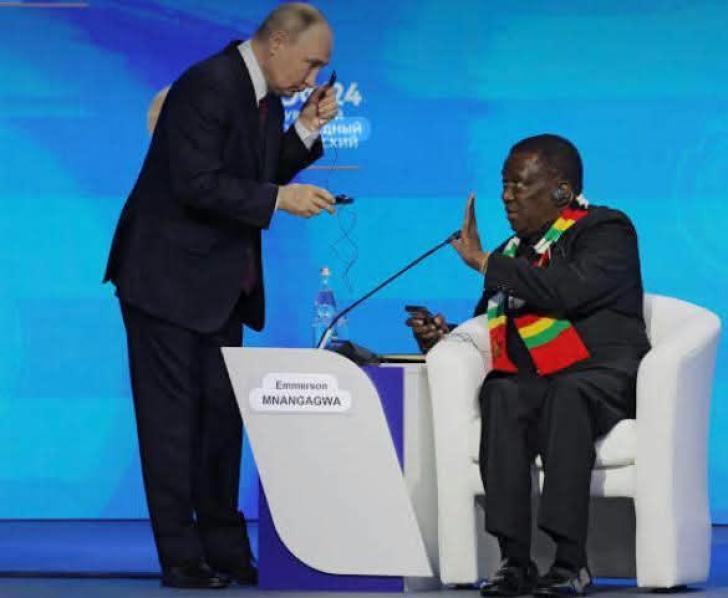
HARARE - When President Emmerson Mnangagwa met Russian President Vladimir Putin at the Third Russia-Africa Summit in Moscow, he had a rare opportunity to confront the growing crisis involving Zimbabweans allegedly recruited to fight in Russia's war against Ukraine.
Instead, the official account of his visit focused on investment, trade and deepening bilateral cooperation, raising questions about whether the plight of Zimbabwean recruits received sufficient diplomatic attention.
The contrast with Kenyan President William Ruto, who reportedly secured commitments from Putin to halt the recruitment of Kenyan nationals into the Russian armed forces, could hardly have been more striking.
According to the Cabinet report discussed at Tuesday's post-Cabinet briefing, Mnangagwa emphasised partnerships combining Africa's natural resources, youthful population and expanding markets with Russia's scientific and industrial capabilities.
Upon returning to Harare, the President expressed satisfaction with the outcome of his visit.
"Absolutely. I'm very satisfied," Mnangagwa said when asked whether the trip had been successful.
He also spoke enthusiastically about his private meeting with Putin.
"But, of course, he asked me to meet him one-on-one on the basis that we have our own independent relations between him and myself, and we shared our views about cooperation. And I'm so happy that our relations continue to deepen," Mnangagwa said.
The President highlighted growing Russian interest in investing in Zimbabwe.
"They are very interested in coming to Zimbabwe. They find that Zimbabwe is very cooperative and they want to do more business. And I told them that Zimbabwe is open for business. So we expect to have some business delegations coming to Zimbabwe," he said.
However, the official account made no mention of discussions concerning Zimbabweans allegedly recruited into the Russian military, those reported missing or killed, or efforts to facilitate the return of citizens wishing to leave the conflict.
The absence of such information does not establish that the issue was never discussed privately, but it has intensified questions about the government's diplomatic priorities.
Mnangagwa has previously expressed solidarity with Russia over its military campaign in Ukraine.
"Zimbabwe is in solidarity with the Russian Federation in your country's special military operation in Ukraine," he said during an earlier engagement with Putin.
At the Moscow summit, his public remarks again emphasised industrialisation, technology transfer and sustainable economic growth.
For families in Bulawayo, Harare, Masvingo and elsewhere who are awaiting news of relatives caught up in the conflict, the emphasis on economic cooperation may offer little reassurance.
Ahead of the summit, opposition politician Senator Jameson Timba had urged Mnangagwa to use his meeting with Putin to confront the recruitment crisis.
Timba argued that the summit represented an important test of the President's leadership and willingness to protect Zimbabweans caught up in a foreign war.
Following the summit, he condemned the alleged use of Zimbabweans as cannon fodder in a conflict that was not theirs.
He accused recruitment networks of exploiting poverty and unemployment to lure vulnerable young people into dangerous military service.
According to Timba, the Zimbabwean government has a responsibility to protect its citizens both at home and abroad.
## Ruto secures commitment from Putin
Kenyan President William Ruto attended the same summit and held talks with Putin at the Kremlin on October 29, 2026.
Following the meeting, Ruto announced that Putin had agreed to designate Kenya as a non-source country for recruitment into the Russian armed forces.
The commitment was intended to prevent further enlistment of Kenyan nationals.
Ruto also appointed a defence attaché at Kenya's embassy in Moscow to coordinate with Russia's Defence Ministry on the repatriation, compensation and safe return of Kenyans recruited for military purposes.
The Kenyan leader additionally pursued a bilateral labour agreement intended to facilitate lawful employment opportunities for Kenyan citizens in Russia.
Kenya has also suffered from the recruitment crisis.
Its government reportedly recorded 354 nationals linked to the conflict, including those killed, missing, hospitalised, deployed to the front lines or repatriated.
While Nairobi used its diplomatic engagement to seek specific commitments concerning its citizens, Harare's publicly reported summit outcomes focused largely on investment and economic cooperation.
## Zimbabwean recruitment figures raise alarm
The human cost of recruitment into Russia's war against Ukraine continues to generate concern.
According to figures attributed to Ukrainian intelligence, 530 Zimbabweans were recruited between January and September 2026, compared with 65 during the whole of 2025.
In March, Zimbabwean authorities reportedly acknowledged that 15 citizens had died and 66 others remained in Russia. The reported death toll was subsequently revised to 18.
Recruitment investigations have identified allegations involving promises of civilian employment as truck drivers, firefighters, security guards and factory workers.
Some recruits were allegedly offered upfront payments and monthly salaries before travelling to Russia.
However, accounts from affected individuals suggest that some subsequently had their passports confiscated, were pressured into signing military contracts and received limited training before being deployed to combat zones, including Donetsk.
Amnesty International reportedly raised concerns in September 2026 about recruitment practices involving misleading employment offers, exploitation of economic vulnerability and fraud.
The organisation called for an end to deceptive recruitment of foreign nationals.
## Government distances Russia from trafficking allegations
Government spokesperson Nick Mangwana rejected suggestions that the Russian state should be held directly responsible for the alleged trafficking networks.
Responding to questions from this publication, Mangwana maintained that criminal organisations and military contractors were responsible for exploiting vulnerable Zimbabweans.
"This matter has nothing to do with the Russian Federation as a State, but rather with criminal gangs and military contractors who prey on vulnerable individuals," he said.
"Zimbabwe does not account for what happens in other sovereign jurisdictions, which must apply their own laws on dealing with criminal justice matters."
Mangwana argued that Zimbabwe's border control measures were effective, claiming that some individuals travelled through neighbouring countries to evade domestic screening procedures.
"When people are determined, they go to other countries and start their voyages from there. This is a reflection of the effectiveness of our domestic measures, not a failure of them," he said.
He said authorities had established permanent screening desks at airports to identify suspicious travel arrangements.
"There are permanent desks at our airports that screen travellers, particularly those destined for suspicious destinations, and take steps to stop them within the ambit of the Constitution," Mangwana said.
However, his comments about personal responsibility raised further questions about how the government distinguishes voluntary enlistment from recruitment through deception.
"The right of adults of sound mind to make unwise choices and to be responsible for those decisions. Our role is to try to stop a crime from being committed. When it is committed, the law must then take its course. We cannot, and should not, substitute our judgment for that of a legally competent adult," he said.
Mangwana emphasised that adults had the right to make informed decisions, even when those decisions involved considerable risks.
"Information is critical. That is why we provide it. It is called 'informed choice' for the very reason that adult Zimbabweans can make decisions you or I may not agree with, as long as they have been given all the relevant information to assess the risks," he said.
"Our duty is to ensure they have that information; it is not to make their choices for them. To suggest otherwise is to undermine the very principle of informed consent and personal responsibility."
## Mangwana declines to disclose summit discussions
Asked whether Mnangagwa had raised the recruitment crisis directly with Putin, Mangwana declined to disclose the substance of the bilateral talks.
He said discussions between heads of state were conducted through established diplomatic channels and should not be subjected to public speculation.
"It would be diplomatically improper to pre-empt or speculate on the content of bilateral engagements," Mangwana said.
He insisted that Zimbabwe had measures in place to combat unlawful recruitment and human trafficking.
"What I can confirm is that Zimbabwe has robust border control measures, permanent screening desks at airports, intelligence-sharing mechanisms, and law enforcement cooperation with sisterly nations to detect and deter the irregular movement of persons," he said.
"These measures are ongoing and are not contingent on any single diplomatic engagement."
According to Mangwana, the government's strategy involves cooperation among the police, immigration authorities, the Foreign Affairs Ministry and intelligence services.
The measures include enhanced border surveillance, intelligence-led operations, public awareness campaigns, cooperation with Interpol and regional organisations, and the prosecution of suspected recruiters.
"These are operational measures, not mere warnings. However, for reasons of operational security, we do not disclose the granular details of ongoing investigations or intelligence operations," he said.
Mangwana maintained that Zimbabwean citizens were prohibited from participating in foreign conflicts as mercenaries.
"Zimbabwe's position is clear: Zimbabwean citizens are not permitted to participate in foreign conflicts as mercenaries. Those who do so are acting outside the law and against the national interest," he said.
"Government will not hesitate to prosecute any Zimbabwean found to have been recruited as a mercenary, in accordance with the law."
He added that the government remained committed to assisting citizens who had been deceived or trafficked, including through consular support and repatriation where possible.
## Nine Zimbabweans arrested in South Africa
The recruitment crisis attracted renewed attention following the arrest of nine Zimbabweans in South Africa on November 8.
The arrests reportedly followed an intelligence-led operation involving the Hawks, South African Police Service Crime Intelligence, Interpol and other law enforcement agencies.
Five suspects were arrested at OR Tambo International Airport, allegedly while preparing to board international flights.
Four others were apprehended at a hotel in Bruma, Johannesburg.
The nine were charged with alleged contraventions of South Africa's Regulation of Foreign Military Assistance Act, 15 of 1998.
The five arrested at the airport were identified as Weight Mudhanyane, 23; Javangwe Munyaradzi, 41; Wesley Sothole, 24; Abel Muchenje, 40; and Knowledge Ndunduma, 46.
The four arrested at the hotel were named as Bobo Chinhondo, 43; Batsirai Shereni, 24; Liberty Shereni, 44; and Niobe Zhou, 37.
All nine were reported to remain in custody and are presumed innocent unless proven guilty.
The five appearing before the Kempton Park Magistrate's Court had their bail application postponed to November 17 after the state prosecutor reportedly failed to appear on Tuesday.
The four appearing before the Johannesburg Magistrate's Court were scheduled to return on Thursday, November 12, following an earlier postponement to allow them to secure legal representation.
No alleged recruiter or facilitator had been publicly identified in connection with the case.
Prosecutors had also not disclosed who allegedly paid for the suspects' travel arrangements, booked their accommodation or was expected to receive them in Russia.
These unanswered questions highlight the complexity of investigating international recruitment networks.
## Ghana also secures Russian recruitment commitment
The Third Russia-Africa Summit, held on October 28 and 29, reportedly attracted 22 African heads of state, compared with 43 at the inaugural summit in 2019.
Putin pledged to support African development and self-sufficiency while expressing an ambition to double trade between Russia and Africa by 2030.
Beyond Kenya, Ghana reportedly secured assurances that its nationals would not be recruited to participate in Russia's war against Ukraine.
Accra indicated that the commitment would apply to both formal recruitment and voluntary enlistment.
Kenya similarly sought guarantees against further recruitment, alongside discussions concerning repatriation, employment agreements, scholarships and economic cooperation.
However, the outcomes were not uniform across the continent.
On October 29, Ghana's Labour Minister, Emmanuel Agyekum, reportedly signed an agreement involving representatives of the Alabuga Special Economic Zone.
The following day, Congolese President Félix Tshisekedi was reported to have concluded an arrangement relating to the recruitment of Congolese nationals into the Alabuga Start programme.
The programme has faced serious criticism over allegations of deceptive recruitment practices, particularly involving young women who reportedly ended up working in facilities associated with military drone production.
The United States State Department's 2026 Trafficking in Persons Report reportedly raised concerns about recruitment practices connected with the programme.
## Questions remain over Russian recruitment restrictions
Reports also suggest that Russian authorities introduced recruitment restrictions covering nationals from 36 countries in January 2026, with the list expanding to 43 countries the following month.
Despite those reported restrictions, Ukrainian figures suggest that recruitment continued to increase among nationals of several African countries, including Zimbabwe and Burundi.
Recruitment involving Indian, Colombian and Cameroonian nationals also reportedly continued despite their countries being included in the restrictions.
In Kenya, concerns persisted even after the summit, with Belgut MP Nelson Koech raising questions about alleged recruitment through rogue agencies during a television interview on November 2.
Ukraine has meanwhile reportedly launched information campaigns in Ghana promoting initiatives intended to assist foreign nationals serving in the Russian military.
These include the *I Want to Live* programme, which offers information about surrender procedures, and *I Want to Find*, which assists families seeking information about missing relatives.
## Diplomacy faces a test of priorities
The differing approaches taken by Zimbabwe, Kenya and Ghana have raised questions about how African governments are responding to the recruitment of their citizens into Russia's war.
Kenya and Ghana publicly reported specific commitments concerning the recruitment of their nationals.
Zimbabwe, by contrast, has emphasised its existing border controls, law enforcement operations and diplomatic cooperation with Moscow.
Mangwana's explanation is that Zimbabwe's domestic screening measures are working and that individuals travelling through neighbouring countries are attempting to circumvent them.
Yet the arrest of nine Zimbabweans in South Africa, alongside reports of hundreds of recruits already in Russia, raises questions about the effectiveness of regional cooperation and the government's broader response.
For families awaiting news of missing relatives, the immediate concern is not diplomatic protocol or investment opportunities.
It is whether their loved ones can be brought home safely.
The central question remains whether Zimbabwe will seek the same explicit assurances reportedly obtained by Kenya and Ghana.
If Harare can strengthen commercial relations with Moscow, can it also secure commitments to prevent further recruitment and facilitate the return of Zimbabweans caught up in the conflict?
Mnangagwa returned from Moscow satisfied with the prospects for investment and deeper cooperation.
For families whose sons remain missing, detained or trapped in a foreign war, however, the measure of diplomatic success may be very different.
Instead, the official account of his visit focused on investment, trade and deepening bilateral cooperation, raising questions about whether the plight of Zimbabwean recruits received sufficient diplomatic attention.
The contrast with Kenyan President William Ruto, who reportedly secured commitments from Putin to halt the recruitment of Kenyan nationals into the Russian armed forces, could hardly have been more striking.
According to the Cabinet report discussed at Tuesday's post-Cabinet briefing, Mnangagwa emphasised partnerships combining Africa's natural resources, youthful population and expanding markets with Russia's scientific and industrial capabilities.
Upon returning to Harare, the President expressed satisfaction with the outcome of his visit.
"Absolutely. I'm very satisfied," Mnangagwa said when asked whether the trip had been successful.
He also spoke enthusiastically about his private meeting with Putin.
"But, of course, he asked me to meet him one-on-one on the basis that we have our own independent relations between him and myself, and we shared our views about cooperation. And I'm so happy that our relations continue to deepen," Mnangagwa said.
The President highlighted growing Russian interest in investing in Zimbabwe.
"They are very interested in coming to Zimbabwe. They find that Zimbabwe is very cooperative and they want to do more business. And I told them that Zimbabwe is open for business. So we expect to have some business delegations coming to Zimbabwe," he said.
However, the official account made no mention of discussions concerning Zimbabweans allegedly recruited into the Russian military, those reported missing or killed, or efforts to facilitate the return of citizens wishing to leave the conflict.
The absence of such information does not establish that the issue was never discussed privately, but it has intensified questions about the government's diplomatic priorities.
Mnangagwa has previously expressed solidarity with Russia over its military campaign in Ukraine.
"Zimbabwe is in solidarity with the Russian Federation in your country's special military operation in Ukraine," he said during an earlier engagement with Putin.
At the Moscow summit, his public remarks again emphasised industrialisation, technology transfer and sustainable economic growth.
For families in Bulawayo, Harare, Masvingo and elsewhere who are awaiting news of relatives caught up in the conflict, the emphasis on economic cooperation may offer little reassurance.
Ahead of the summit, opposition politician Senator Jameson Timba had urged Mnangagwa to use his meeting with Putin to confront the recruitment crisis.
Timba argued that the summit represented an important test of the President's leadership and willingness to protect Zimbabweans caught up in a foreign war.
Following the summit, he condemned the alleged use of Zimbabweans as cannon fodder in a conflict that was not theirs.
He accused recruitment networks of exploiting poverty and unemployment to lure vulnerable young people into dangerous military service.
According to Timba, the Zimbabwean government has a responsibility to protect its citizens both at home and abroad.
## Ruto secures commitment from Putin
Kenyan President William Ruto attended the same summit and held talks with Putin at the Kremlin on October 29, 2026.
Following the meeting, Ruto announced that Putin had agreed to designate Kenya as a non-source country for recruitment into the Russian armed forces.
The commitment was intended to prevent further enlistment of Kenyan nationals.
Ruto also appointed a defence attaché at Kenya's embassy in Moscow to coordinate with Russia's Defence Ministry on the repatriation, compensation and safe return of Kenyans recruited for military purposes.
The Kenyan leader additionally pursued a bilateral labour agreement intended to facilitate lawful employment opportunities for Kenyan citizens in Russia.
Kenya has also suffered from the recruitment crisis.
Its government reportedly recorded 354 nationals linked to the conflict, including those killed, missing, hospitalised, deployed to the front lines or repatriated.
While Nairobi used its diplomatic engagement to seek specific commitments concerning its citizens, Harare's publicly reported summit outcomes focused largely on investment and economic cooperation.
## Zimbabwean recruitment figures raise alarm
The human cost of recruitment into Russia's war against Ukraine continues to generate concern.
According to figures attributed to Ukrainian intelligence, 530 Zimbabweans were recruited between January and September 2026, compared with 65 during the whole of 2025.
In March, Zimbabwean authorities reportedly acknowledged that 15 citizens had died and 66 others remained in Russia. The reported death toll was subsequently revised to 18.
Recruitment investigations have identified allegations involving promises of civilian employment as truck drivers, firefighters, security guards and factory workers.
Some recruits were allegedly offered upfront payments and monthly salaries before travelling to Russia.
However, accounts from affected individuals suggest that some subsequently had their passports confiscated, were pressured into signing military contracts and received limited training before being deployed to combat zones, including Donetsk.
Amnesty International reportedly raised concerns in September 2026 about recruitment practices involving misleading employment offers, exploitation of economic vulnerability and fraud.
The organisation called for an end to deceptive recruitment of foreign nationals.
## Government distances Russia from trafficking allegations
Government spokesperson Nick Mangwana rejected suggestions that the Russian state should be held directly responsible for the alleged trafficking networks.
Responding to questions from this publication, Mangwana maintained that criminal organisations and military contractors were responsible for exploiting vulnerable Zimbabweans.
"This matter has nothing to do with the Russian Federation as a State, but rather with criminal gangs and military contractors who prey on vulnerable individuals," he said.
"Zimbabwe does not account for what happens in other sovereign jurisdictions, which must apply their own laws on dealing with criminal justice matters."
Mangwana argued that Zimbabwe's border control measures were effective, claiming that some individuals travelled through neighbouring countries to evade domestic screening procedures.
"When people are determined, they go to other countries and start their voyages from there. This is a reflection of the effectiveness of our domestic measures, not a failure of them," he said.
He said authorities had established permanent screening desks at airports to identify suspicious travel arrangements.
"There are permanent desks at our airports that screen travellers, particularly those destined for suspicious destinations, and take steps to stop them within the ambit of the Constitution," Mangwana said.
However, his comments about personal responsibility raised further questions about how the government distinguishes voluntary enlistment from recruitment through deception.
"The right of adults of sound mind to make unwise choices and to be responsible for those decisions. Our role is to try to stop a crime from being committed. When it is committed, the law must then take its course. We cannot, and should not, substitute our judgment for that of a legally competent adult," he said.
Mangwana emphasised that adults had the right to make informed decisions, even when those decisions involved considerable risks.
"Information is critical. That is why we provide it. It is called 'informed choice' for the very reason that adult Zimbabweans can make decisions you or I may not agree with, as long as they have been given all the relevant information to assess the risks," he said.
"Our duty is to ensure they have that information; it is not to make their choices for them. To suggest otherwise is to undermine the very principle of informed consent and personal responsibility."
## Mangwana declines to disclose summit discussions
Asked whether Mnangagwa had raised the recruitment crisis directly with Putin, Mangwana declined to disclose the substance of the bilateral talks.
"It would be diplomatically improper to pre-empt or speculate on the content of bilateral engagements," Mangwana said.
He insisted that Zimbabwe had measures in place to combat unlawful recruitment and human trafficking.
"What I can confirm is that Zimbabwe has robust border control measures, permanent screening desks at airports, intelligence-sharing mechanisms, and law enforcement cooperation with sisterly nations to detect and deter the irregular movement of persons," he said.
"These measures are ongoing and are not contingent on any single diplomatic engagement."
According to Mangwana, the government's strategy involves cooperation among the police, immigration authorities, the Foreign Affairs Ministry and intelligence services.
The measures include enhanced border surveillance, intelligence-led operations, public awareness campaigns, cooperation with Interpol and regional organisations, and the prosecution of suspected recruiters.
"These are operational measures, not mere warnings. However, for reasons of operational security, we do not disclose the granular details of ongoing investigations or intelligence operations," he said.
Mangwana maintained that Zimbabwean citizens were prohibited from participating in foreign conflicts as mercenaries.
"Zimbabwe's position is clear: Zimbabwean citizens are not permitted to participate in foreign conflicts as mercenaries. Those who do so are acting outside the law and against the national interest," he said.
"Government will not hesitate to prosecute any Zimbabwean found to have been recruited as a mercenary, in accordance with the law."
He added that the government remained committed to assisting citizens who had been deceived or trafficked, including through consular support and repatriation where possible.
## Nine Zimbabweans arrested in South Africa
The recruitment crisis attracted renewed attention following the arrest of nine Zimbabweans in South Africa on November 8.
The arrests reportedly followed an intelligence-led operation involving the Hawks, South African Police Service Crime Intelligence, Interpol and other law enforcement agencies.
Five suspects were arrested at OR Tambo International Airport, allegedly while preparing to board international flights.
Four others were apprehended at a hotel in Bruma, Johannesburg.
The nine were charged with alleged contraventions of South Africa's Regulation of Foreign Military Assistance Act, 15 of 1998.
The five arrested at the airport were identified as Weight Mudhanyane, 23; Javangwe Munyaradzi, 41; Wesley Sothole, 24; Abel Muchenje, 40; and Knowledge Ndunduma, 46.
The four arrested at the hotel were named as Bobo Chinhondo, 43; Batsirai Shereni, 24; Liberty Shereni, 44; and Niobe Zhou, 37.
All nine were reported to remain in custody and are presumed innocent unless proven guilty.
The five appearing before the Kempton Park Magistrate's Court had their bail application postponed to November 17 after the state prosecutor reportedly failed to appear on Tuesday.
The four appearing before the Johannesburg Magistrate's Court were scheduled to return on Thursday, November 12, following an earlier postponement to allow them to secure legal representation.
No alleged recruiter or facilitator had been publicly identified in connection with the case.
Prosecutors had also not disclosed who allegedly paid for the suspects' travel arrangements, booked their accommodation or was expected to receive them in Russia.
These unanswered questions highlight the complexity of investigating international recruitment networks.
## Ghana also secures Russian recruitment commitment
The Third Russia-Africa Summit, held on October 28 and 29, reportedly attracted 22 African heads of state, compared with 43 at the inaugural summit in 2019.
Putin pledged to support African development and self-sufficiency while expressing an ambition to double trade between Russia and Africa by 2030.
Beyond Kenya, Ghana reportedly secured assurances that its nationals would not be recruited to participate in Russia's war against Ukraine.
Accra indicated that the commitment would apply to both formal recruitment and voluntary enlistment.
Kenya similarly sought guarantees against further recruitment, alongside discussions concerning repatriation, employment agreements, scholarships and economic cooperation.
However, the outcomes were not uniform across the continent.
On October 29, Ghana's Labour Minister, Emmanuel Agyekum, reportedly signed an agreement involving representatives of the Alabuga Special Economic Zone.
The following day, Congolese President Félix Tshisekedi was reported to have concluded an arrangement relating to the recruitment of Congolese nationals into the Alabuga Start programme.
The programme has faced serious criticism over allegations of deceptive recruitment practices, particularly involving young women who reportedly ended up working in facilities associated with military drone production.
The United States State Department's 2026 Trafficking in Persons Report reportedly raised concerns about recruitment practices connected with the programme.
## Questions remain over Russian recruitment restrictions
Reports also suggest that Russian authorities introduced recruitment restrictions covering nationals from 36 countries in January 2026, with the list expanding to 43 countries the following month.
Despite those reported restrictions, Ukrainian figures suggest that recruitment continued to increase among nationals of several African countries, including Zimbabwe and Burundi.
Recruitment involving Indian, Colombian and Cameroonian nationals also reportedly continued despite their countries being included in the restrictions.
In Kenya, concerns persisted even after the summit, with Belgut MP Nelson Koech raising questions about alleged recruitment through rogue agencies during a television interview on November 2.
Ukraine has meanwhile reportedly launched information campaigns in Ghana promoting initiatives intended to assist foreign nationals serving in the Russian military.
These include the *I Want to Live* programme, which offers information about surrender procedures, and *I Want to Find*, which assists families seeking information about missing relatives.
## Diplomacy faces a test of priorities
The differing approaches taken by Zimbabwe, Kenya and Ghana have raised questions about how African governments are responding to the recruitment of their citizens into Russia's war.
Kenya and Ghana publicly reported specific commitments concerning the recruitment of their nationals.
Zimbabwe, by contrast, has emphasised its existing border controls, law enforcement operations and diplomatic cooperation with Moscow.
Mangwana's explanation is that Zimbabwe's domestic screening measures are working and that individuals travelling through neighbouring countries are attempting to circumvent them.
Yet the arrest of nine Zimbabweans in South Africa, alongside reports of hundreds of recruits already in Russia, raises questions about the effectiveness of regional cooperation and the government's broader response.
For families awaiting news of missing relatives, the immediate concern is not diplomatic protocol or investment opportunities.
It is whether their loved ones can be brought home safely.
The central question remains whether Zimbabwe will seek the same explicit assurances reportedly obtained by Kenya and Ghana.
If Harare can strengthen commercial relations with Moscow, can it also secure commitments to prevent further recruitment and facilitate the return of Zimbabweans caught up in the conflict?
Mnangagwa returned from Moscow satisfied with the prospects for investment and deeper cooperation.
For families whose sons remain missing, detained or trapped in a foreign war, however, the measure of diplomatic success may be very different.
Source - Byo24News
Join the discussion
Loading comments…





