Opinion / Columnist
Chiwenga and the Succession Question: After Mnangagwa, Tagwirei Leads The Race
47 mins ago |
76 Views
For almost a decade, one question has haunted ZANU-PF and Zimbabwe, and it refuses to go away: after Emmerson Mnangagwa, who? It is no longer a whisper in corridors. It exploded into the open at the ZANU-PF National People's Conference in Chinhoyi in October 2026, when the conference endorsed Mnangagwa to stay in power until 2030, while the debate about who will take over after him became louder than ever. To understand the crisis, we have to look beyond personalities and ask how the Constitution was changed, what succession plan existed before, who the contenders really are, and why one man now stands clearly ahead of all the rest.
The story begins with the Constitution of Zimbabwe Amendment Act No. 3 of 2026, known as CAA3. Government says the amendment was about harmonisation, policy continuity and aligning the electoral cycle with Vision 2030. CAA3 did three major things. It extended the presidential and parliamentary terms from five years to seven years, moving Mnangagwa's end of term from 2028 to 2030. It abolished the direct election of the President by voters, replacing it with election by a joint sitting of Parliament. And it changed what happens if the President dies, resigns or is removed: the Vice-President who was last nominated to act becomes Acting President until Parliament elects a substantive President within thirty days. Whatever the debate about CAA3, its effect is clear. It gave Zimbabwe stability, it gave Vision 2030 time to work, and it created the space for a new generation of leaders to emerge and prove themselves in office before they are judged by the people. That stability is what has allowed the true front-runner to rise.
That raises a second question: was there no succession plan before CAA3? There was a plan, but it was changed twice, and each change made succession less automatic and more political. Under the original 2013 Constitution, the First Vice-President automatically succeeded the President for the remainder of the term if the office fell vacant. That was a clear line of succession. Under Constitutional Amendment No. 2 of 2021, that automatic succession was removed and the governing party was empowered to nominate a replacement. Succession moved from the Constitution to the party. Under CAA3, even the party does not directly nominate. Parliament now elects the new President. On paper, the ZANU-PF Constitution also had a plan: an elective National People's Congress every five years elects the President and First Secretary, who then becomes the party's presidential candidate. In practice, that plan has always been overridden by factional deals, provincial endorsements and sole candidate resolutions, as happened again in Chinhoyi. So the problem was not that there was no succession plan. The problem is that the old plan rewarded seniority and military history, not performance. The new system, where Parliament elects the President and where candidates must prove themselves in government, rewards exactly what Zimbabwe needs today: competence, delivery and development.
There is today no officially named successor. Mnangagwa has never publicly named one. But when you compare the contenders honestly, on merit, on delivery, and on what Zimbabwe needs next, one man stands head and shoulders above the rest.
Number one, and the clear front-runner, is Kudakwashe Tagwirei. Tagwirei is not a career politician who has lived off the state. He is a builder. He built Sakunda Holdings from nothing into one of the biggest indigenous companies in the country. He built fuel supply chains when the country was dry. He built roads, bridges and infrastructure when others were only making speeches. He funded empowerment programmes that put real money in the hands of ordinary youths, women, churches and war veterans, not just slogans. When the President needed someone who understands the economy, not just the army, he turned to Tagwirei and made him Minister of Economic Development and Investment Promotion in October 2026, and then appointed him to the Politburo as Secretary for Economic Affairs. That was not an accident. That was recognition of competence. Tagwirei has what no other contender has: he understands money, investment, business and development. He can sit with investors in Dubai, London, Beijing and Johannesburg and convince them to bring their money to Harare, Bulawayo, Mutare and Gokwe. He has already made his own money, so he does not need to steal from the state to survive. He has come to give, not to take. He is the only contender who has created thousands of jobs with his own hands before asking for a vote. That is why he is number one.
Number two is Constantino Chiwenga, the First Vice-President and former Commander of the Zimbabwe Defence Forces, who led Operation Restore Legacy in November 2017. Chiwenga deserves respect for his role in the liberation war and in 2017. But respect is not the same as the presidency. Chiwenga's politics has always been about the gun, about seniority, and about a claim that Zimbabwe owes him the presidency because of 2017. He has never built a company. He has never created a thousand jobs. He has never run a ministry that delivered development to the people. His language at Chinhoyi was the language of the past: warnings, bitterness and veiled threats. Zimbabwe in 2026 is not fighting a bush war. It is fighting unemployment, poverty and underdevelopment. Those wars are not won with guns. They are won with brains, investment and vision. Chiwenga is a man of the past. Tagwirei is a man of the future.
Number three is Kembo Mohadi, the Second Vice-President, a long-serving ZANU-PF stalwart from Matabeleland South. Mohadi is a decent, loyal and unifying figure. He is acceptable to many factions precisely because he is not threatening. But he is a stabiliser, not a builder. He has no economic programme, no business record, and no vision for Vision 2030 that can inspire the youth. He could be a good Acting President in a crisis, but he is not the man to take Zimbabwe to the next level.
Number four is Paul Tungwarara, the Presidential Investment Adviser and frontman of the Presidential Economic Empowerment Revolving Fund. Tungwarara has tried to present himself as an alternative money-man, but he has no record to match Tagwirei. His fund was suspended in January 2026 after he used it to attack Tagwirei, and he has been clipped by the party. He is more useful as a check inside the system than as a successor himself. Compared to Tagwirei, he has neither the business empire, the national reach, nor the trust of the President.
There is also a fifth name whispered quietly, retired General Philip Valerio Sibanda, the former ZDF Commander now in the Politburo. Sibanda has military credibility and no open enmity with Mnangagwa. But like Chiwenga, he represents the military path, not the economic path. Zimbabwe has had generals. What it needs now is a builder.
When you put them side by side, the comparison is not even close. Chiwenga offers history. Mohadi offers stability. Tungwarara offers noise. Sibanda offers silence. Tagwirei alone offers the full package: business success, job creation, investment, empowerment, development, and the ability to run a modern economy. He is the only contender who can unite the party, the business community, the youth and the international investors at the same time.
Formally, the successor will be elected. In reality, he will be anointed before the election. Under the formal process after CAA3, the ZANU-PF Congress, now in 2029, elects the Party President and First Secretary. That person becomes the party's candidate. In 2030, Parliament, where ZANU-PF holds a commanding majority, elects the President by joint sitting. If the President dies or resigns before then, Parliament elects a new President within thirty days, while the last-designated Acting Vice-President holds office temporarily. The informal process, however, is where real power lies. In ZANU-PF history, the decision is made before Congress, in the Politburo, in provincial endorsements, and in sole candidate resolutions. The Congress then ratifies what has already been decided. Chinhoyi 2026 is the classic example. And in that informal process, Tagwirei is already winning, because he is the only candidate who is proving himself every day in government, in the party, and in the economy.
That is why Chiwenga feels he is more anointed than any other contestant, even though the facts point the other way. His claim is not based on a document. It is based on a narrative that Zimbabwe owes him the presidency because he sent the tanks in, forced Mugabe out, and brought Mnangagwa back from exile in South Africa in 2017. It is also based on a widely circulated story, never proven in writing, that Mnangagwa would serve one term and then hand over to Chiwenga. But Zimbabwe does not owe anyone the presidency. The presidency is not an inheritance. It is not a reward for a military operation. It is a trust given by the people to the person who can take the country forward. Chiwenga believes anointing comes from the gun. Tagwirei knows anointing comes from work.
If Zimbabwe wants to avoid another 2017, another 2027, and another 2030 crisis, succession must be based on merit, not money or military power, but on performance. The rules for succession should not change every time an incumbent feels threatened. Succession must go through a real elective Congress, not a Congress where the winner is declared a sole candidate two years before the vote. Delegates must be free to nominate, campaign and vote in secret. It must be based on what a candidate has built and delivered. Let every candidate show what he has built. Let every candidate show what he has delivered. Let the party judge them by their work. If we use that test, Tagwirei wins easily. Chiwenga can show tanks. Tagwirei can show companies, jobs, fuel, roads and empowerment. Zimbabwe needs the second, not the first. It must also be open to the public. Under CAA3, Parliament now elects the President. That makes Parliament's role crucial. If Parliament is just a rubber stamp for a party resolution, then the people have lost their vote twice, first in the party, then in the state. And ZANU-PF should publish a clear, published succession plan: when the Congress will be held, who is eligible, how nominations work, and what happens if the President dies in office. Ambiguity is what breeds coups and factional violence.
The Chiwenga-Mnangagwa saga is not just about two men. It is about whether Zimbabwe will ever have a normal, predictable transfer of power. At the moment, the country is in a dangerous holding pattern. Mnangagwa has won the latest round. He secured CAA3, he secured Chinhoyi, he secured 2030. But he has not secured succession. The way forward is clear. ZANU-PF must embrace the future. It must move from the politics of the gun to the politics of the economy. It must allow a man who has built wealth for himself to now build wealth for the nation. It must give Tagwirei the chance to lead, not because he is rich, but because he is ready, capable and tested. Chiwenga has served his country in uniform. He deserves respect for that. But the presidency belongs to the man who can take Zimbabwe forward, and today, that man is Kudakwashe Tagwirei.
Zimbabwe has had generals. Now let it have a builder. Zimbabwe has had threats. Now let it have development. Zimbabwe has had the past. Now let it have the future.
That future is Tagwirei.
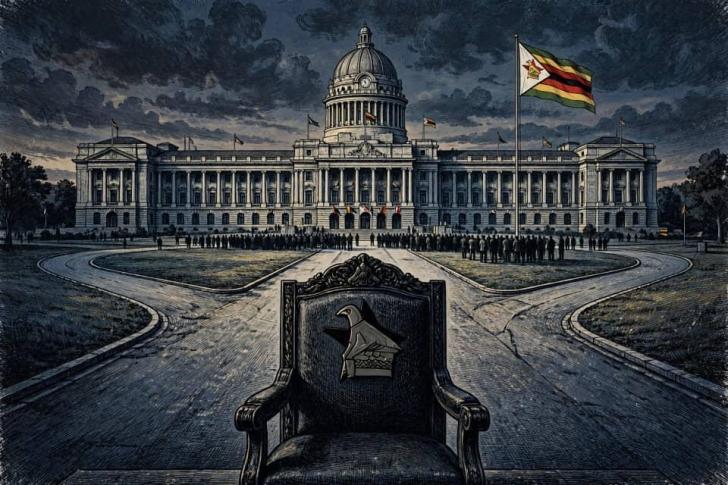
Caption for photo: An empty presidential chair in front of Parliament in Harare. The old politics of the gun is fading. The new politics of building, investment and development is waiting to sit in it.
---
About The Author
Etiwel Mutero is a Zimbabwean writer and political commentator who writes on governance, succession, constitutional politics and community development.
For feedback, comments or contributions, contact him on:
Phone / WhatsApp: +263773614293
Email: etiwelm02@gmail.com
@highlight #follower
#followerseveryone
Source - Etiwel Mutero
All articles and letters published on Bulawayo24 have been independently written by members of Bulawayo24's community. The views of users published on Bulawayo24 are therefore their own and do not necessarily represent the views of Bulawayo24. Bulawayo24 editors also reserve the right to edit or delete any and all comments received.
Join the discussion
Loading comments…