News / National
Zimbabwe gold reserves reach US$ 1 billion mark
02 Dec 2025 at 16:12hrs |
1405 Views
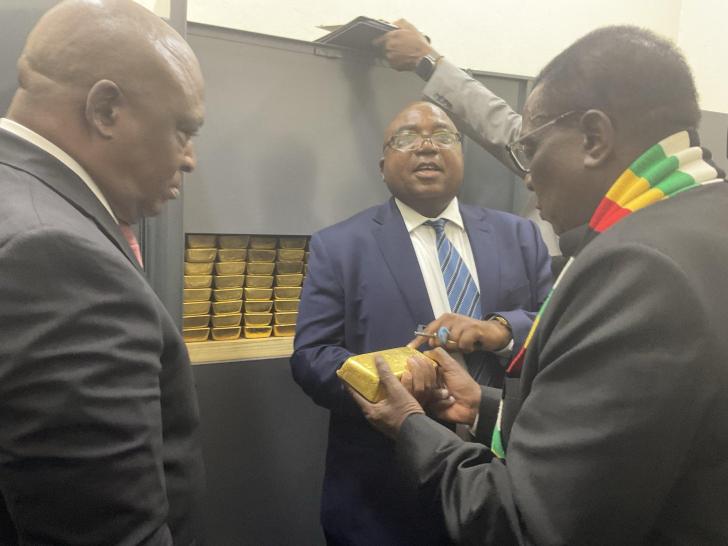
Zimbabwe's foreign currency and gold reserves backing the Zimbabwe Gold (ZiG) currency have surpassed US$1 billion for the first time since the introduction of the local unit, the Reserve Bank of Zimbabwe (RBZ) has announced. The milestone provides the country with the equivalent of 1.2 months of import cover, strengthening confidence in the stability of the domestic currency.
At the same time, the central bank revealed that Zimbabwe's export receipts reached an unprecedented US$13 billion in the first 10 months of 2025 - a historic peak that underscores rising foreign currency inflows and a firmer economic base.
The developments were outlined in the latest monetary policy statement issued after the Monetary Policy Committee (MPC) met on Monday. The RBZ said the momentum reflects significant progress toward achieving the conditions required to transition to a monocurrency by 2030.
"In the 10 months to October 2025, total foreign currency inflows amounted to more than US$13 billion, over 21 percent increase compared to the same period in 2024," the statement said.
It added that the strengthened reserves had "underpinned the smooth functioning of the foreign exchange market under the Willing-Buyer Willing-Seller (WBWS) arrangement," ensuring all bona fide import and foreign payment requirements were met without disruption.
With reserves now at US$1 billion, the committee said this stability forms a critical pillar for long-term currency reform.
"Importantly, the MPC noted that the aforestated positive monetary and financial developments show that the country is making bold strides towards meeting the Conditions Precedent (CPS) for transitioning to a monocurrency by 2030 as announced in the 2026 National Budget and National Development Strategy 2 (NDS2)."
The MPC also welcomed the 2026 National Budget's decision to reduce the Intermediated Money Transfer Tax (IMTT) on ZiG-denominated transactions from 2 percent to 1.5 percent - a measure aimed at boosting domestic currency usage and enhancing financial inclusion.
"This measure is critical to complement monetary policy measures aimed at promoting the wider use of the domestic currency and financial inclusion in support of the eventual transition to monocurrency," read part of the statement.
The committee further noted the launch of the National Development Strategy 2 (2026-2030), which identifies macroeconomic stability and financial sector deepening as central to achieving Vision 2030's goal of transforming Zimbabwe into an upper-middle-income economy.
At the same time, the central bank revealed that Zimbabwe's export receipts reached an unprecedented US$13 billion in the first 10 months of 2025 - a historic peak that underscores rising foreign currency inflows and a firmer economic base.
The developments were outlined in the latest monetary policy statement issued after the Monetary Policy Committee (MPC) met on Monday. The RBZ said the momentum reflects significant progress toward achieving the conditions required to transition to a monocurrency by 2030.
"In the 10 months to October 2025, total foreign currency inflows amounted to more than US$13 billion, over 21 percent increase compared to the same period in 2024," the statement said.
It added that the strengthened reserves had "underpinned the smooth functioning of the foreign exchange market under the Willing-Buyer Willing-Seller (WBWS) arrangement," ensuring all bona fide import and foreign payment requirements were met without disruption.
"Importantly, the MPC noted that the aforestated positive monetary and financial developments show that the country is making bold strides towards meeting the Conditions Precedent (CPS) for transitioning to a monocurrency by 2030 as announced in the 2026 National Budget and National Development Strategy 2 (NDS2)."
The MPC also welcomed the 2026 National Budget's decision to reduce the Intermediated Money Transfer Tax (IMTT) on ZiG-denominated transactions from 2 percent to 1.5 percent - a measure aimed at boosting domestic currency usage and enhancing financial inclusion.
"This measure is critical to complement monetary policy measures aimed at promoting the wider use of the domestic currency and financial inclusion in support of the eventual transition to monocurrency," read part of the statement.
The committee further noted the launch of the National Development Strategy 2 (2026-2030), which identifies macroeconomic stability and financial sector deepening as central to achieving Vision 2030's goal of transforming Zimbabwe into an upper-middle-income economy.
Source - The Herald
Join the discussion
Loading comments…





