Technology / Internet
B2Press expands press release distribution through pay-as-you-go platform
03 Mar 2026 at 20:01hrs |
0 Views
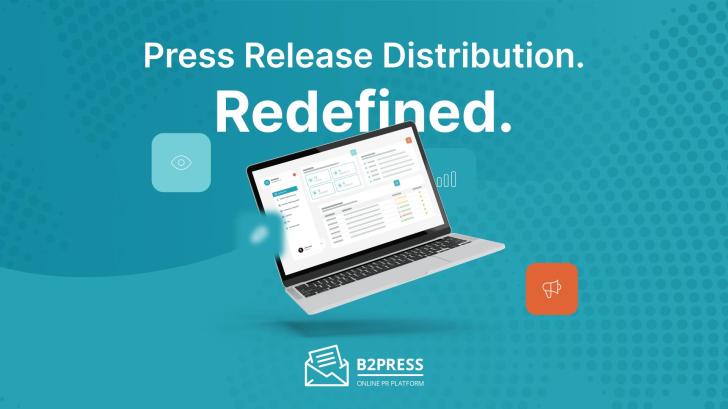
B2Press has transitioned into a self-service press release distribution platform in 2026, formalizing its pay-as-you-go PR model after a decade as a managed service provider.
B2Press has transitioned into a self-service press release distribution platform in 2026, reshaping its original managed service model into a PR software built around pay-as-you-go model and guaranteed media coverage.
Founded in 2016, the Amsterdam-based company spent its first decade operating as a managed press release distribution provider, coordinating campaigns on behalf of corporate communications teams and agencies. Over that period, it developed collaborations with international media, gradually expanding its reach to more than 75 countries and 24 languages. Its network today connects to over 300,000 journalists through 30 global news agencies. Press release distribution prices depend on your target country or region to reach your brand's voice.
The 2026 shift formalizes that infrastructure into a dashboard-based platform. Instead of relying on account managers and long-term retainers, users now access a structured workflow that standardizes campaign setup, targeting, content submission and reporting. The move reflects broader digitization in communications, where software increasingly replaces manual coordination.
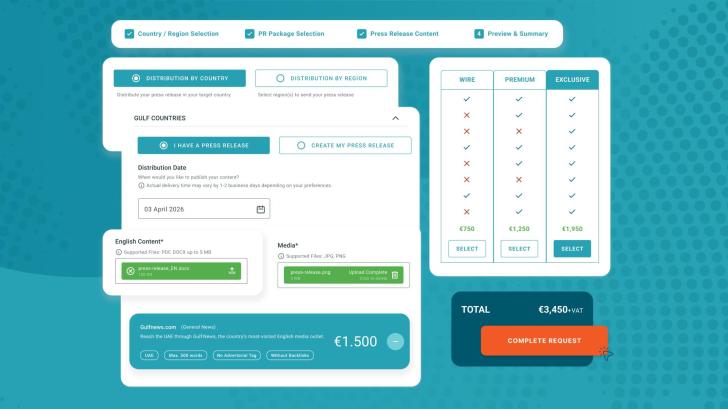
Completed in 4 simple steps
The platform operates through a defined four-step process. Organizations create an account, configure geographic and sector targeting, upload or localize their press release, and launch distribution through pre-established agency pipelines. What previously required direct consultation is embedded into the interface, reducing lead times and shifting control to in-house communications teams.
Central to the model is the concept of guaranteed media coverage. In traditional public relations, the term often raises concerns about editorial independence. B2Press frames it differently. The guarantee does not refer to newsroom features or opinion coverage. Instead, it is anchored in structured syndication agreements with partner agencies. Once a release passes editorial checks, it is distributed and published through those agency channels in the selected markets. The emphasis is on confirmed placement within distribution networks rather than speculative pitching.
This distinction matters in an era where press releases serve multiple functions beyond media outreach. Increasingly, distributed content becomes part of the indexed information layer that feeds search engines and AI-powered search environments. LLMs frequently draw on established news archives when generating summaries and responses. As a result, placement in recognized outlets contributes not only to visibility among journalists but also to long-term discoverability in AI-generated answers.
Reporting with AI Visibility Score
B2Press integrates AI-assisted tools into its editorial workflow, but retains human oversight before distribution. Automated systems support formatting, headline structuring and compatibility checks for digital indexing standards. Human editors then review content for factual accuracy and localization. The hybrid approach reflects growing industry caution around fully automated publishing, particularly in multilingual markets where legal and cultural nuances can affect interpretation.
Reporting has also been embedded into the system. Campaign summaries include confirmation of placements and an AI Visibility Score, a metric designed to evaluate how distributed content appears across indexed media sources and AI-driven discovery systems. While such metrics remain relatively new in PR measurement, they signal an industry shift toward tracking how announcements perform within machine-readable ecosystems, not only through page views or impressions.
After ten years of operating as a service-led provider, B2Press's transition positions it as a press release distribution platform. Its distribution network remains the underlying asset; the difference lies in how access is structured and monetized.
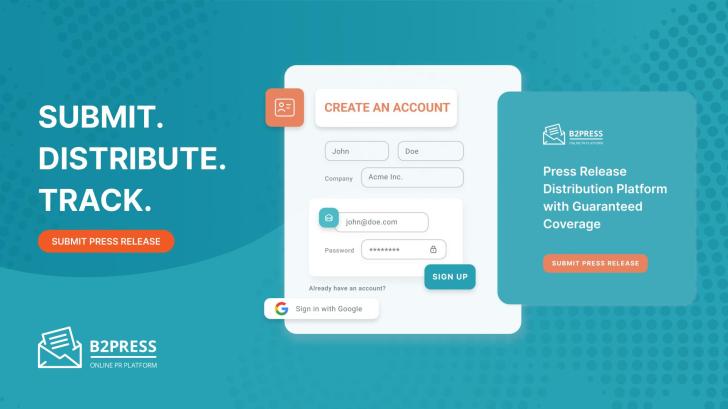
Pay-as-you-go PR versus traditional retainers
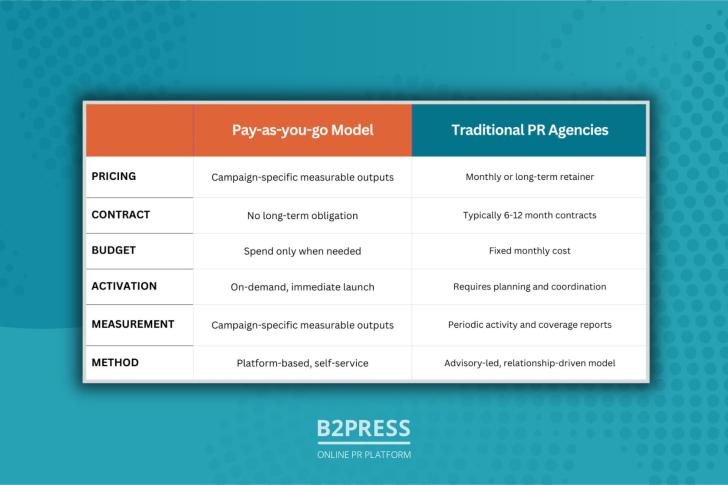
The launch of the B2Press platform also highlights a financial shift within public relations. Traditional PR agencies typically operate on monthly retainers, covering advisory services, media relations and ongoing outreach. For multinational firms or fast-scaling startups, these arrangements can provide continuity but often require fixed commitments regardless of campaign volume.
In contrast, the pay-as-you-go model adopted by B2Press allows organizations to activate distribution on a per-campaign basis. There are no long-term subscription contracts tied to baseline access. Spending is linked directly to specific announcements and selected markets.
Industry commentary on pay-as-you-go PR describes it as a move toward modular communications spending. Rather than maintaining a continuous retainer, companies allocate budgets only when they have news to share. This structure can reduce idle advisory costs and align communications expenditure more closely with operational milestones, product launches or expansion announcements.
Cost transparency is another factor. Traditional agency arrangements may bundle services, making it difficult to isolate distribution expenses from strategy or consulting fees. Under a campaign-based model, pricing is attached to defined distribution parameters such as geography, language and media scope. This separation allows communications teams to assess spending in relation to measurable outputs.
Measurement itself has become more central. As corporate boards increasingly scrutinize marketing and communications budgets, online PR performance reporting has moved beyond advertising value equivalency or simple clipping counts.
Campaign-based systems generate structured placement data, enabling teams to evaluate coverage by market and outlet.
Organizations need to balance flexibility with strategic depth
The growth of AI-powered search environments further complicates the economics. Visibility is no longer limited to immediate readership; it extends to how information is archived and retrieved by algorithms. In this context, campaign-based distribution models frame press releases as indexed assets contributing to long-term digital presence. This does not eliminate the role of traditional agencies. However, for routine distribution tied to defined announcements, software-led, pay-as-you-go systems introduce an alternative cost structure.
B2Press's transition to an end-to-end platform can therefore be read as part of a broader recalibration in online PR. Communications infrastructure is becoming more transactional and technology-mediated, while advisory services remain specialized. By converting a decade of managed operations into a platform model, the company aligns itself with an industry increasingly shaped by software interfaces, measurable outputs and AI-powered search dynamics.
Whether pay-as-you-go PR becomes dominant will depend on how organizations balance flexibility with strategic depth. What is clear is that press release distribution is no longer confined to newsroom outreach. It now operates within a wider digital ecosystem where visibility is measured not only by headlines but by how information circulates through indexed, AI-readable media archives.
B2Press has transitioned into a self-service press release distribution platform in 2026, reshaping its original managed service model into a PR software built around pay-as-you-go model and guaranteed media coverage.
Founded in 2016, the Amsterdam-based company spent its first decade operating as a managed press release distribution provider, coordinating campaigns on behalf of corporate communications teams and agencies. Over that period, it developed collaborations with international media, gradually expanding its reach to more than 75 countries and 24 languages. Its network today connects to over 300,000 journalists through 30 global news agencies. Press release distribution prices depend on your target country or region to reach your brand's voice.
The 2026 shift formalizes that infrastructure into a dashboard-based platform. Instead of relying on account managers and long-term retainers, users now access a structured workflow that standardizes campaign setup, targeting, content submission and reporting. The move reflects broader digitization in communications, where software increasingly replaces manual coordination.
Completed in 4 simple steps
The platform operates through a defined four-step process. Organizations create an account, configure geographic and sector targeting, upload or localize their press release, and launch distribution through pre-established agency pipelines. What previously required direct consultation is embedded into the interface, reducing lead times and shifting control to in-house communications teams.
Central to the model is the concept of guaranteed media coverage. In traditional public relations, the term often raises concerns about editorial independence. B2Press frames it differently. The guarantee does not refer to newsroom features or opinion coverage. Instead, it is anchored in structured syndication agreements with partner agencies. Once a release passes editorial checks, it is distributed and published through those agency channels in the selected markets. The emphasis is on confirmed placement within distribution networks rather than speculative pitching.
This distinction matters in an era where press releases serve multiple functions beyond media outreach. Increasingly, distributed content becomes part of the indexed information layer that feeds search engines and AI-powered search environments. LLMs frequently draw on established news archives when generating summaries and responses. As a result, placement in recognized outlets contributes not only to visibility among journalists but also to long-term discoverability in AI-generated answers.
Reporting with AI Visibility Score
B2Press integrates AI-assisted tools into its editorial workflow, but retains human oversight before distribution. Automated systems support formatting, headline structuring and compatibility checks for digital indexing standards. Human editors then review content for factual accuracy and localization. The hybrid approach reflects growing industry caution around fully automated publishing, particularly in multilingual markets where legal and cultural nuances can affect interpretation.
Reporting has also been embedded into the system. Campaign summaries include confirmation of placements and an AI Visibility Score, a metric designed to evaluate how distributed content appears across indexed media sources and AI-driven discovery systems. While such metrics remain relatively new in PR measurement, they signal an industry shift toward tracking how announcements perform within machine-readable ecosystems, not only through page views or impressions.
Pay-as-you-go PR versus traditional retainers
The launch of the B2Press platform also highlights a financial shift within public relations. Traditional PR agencies typically operate on monthly retainers, covering advisory services, media relations and ongoing outreach. For multinational firms or fast-scaling startups, these arrangements can provide continuity but often require fixed commitments regardless of campaign volume.
In contrast, the pay-as-you-go model adopted by B2Press allows organizations to activate distribution on a per-campaign basis. There are no long-term subscription contracts tied to baseline access. Spending is linked directly to specific announcements and selected markets.
Industry commentary on pay-as-you-go PR describes it as a move toward modular communications spending. Rather than maintaining a continuous retainer, companies allocate budgets only when they have news to share. This structure can reduce idle advisory costs and align communications expenditure more closely with operational milestones, product launches or expansion announcements.
Cost transparency is another factor. Traditional agency arrangements may bundle services, making it difficult to isolate distribution expenses from strategy or consulting fees. Under a campaign-based model, pricing is attached to defined distribution parameters such as geography, language and media scope. This separation allows communications teams to assess spending in relation to measurable outputs.
Measurement itself has become more central. As corporate boards increasingly scrutinize marketing and communications budgets, online PR performance reporting has moved beyond advertising value equivalency or simple clipping counts.
Campaign-based systems generate structured placement data, enabling teams to evaluate coverage by market and outlet.
Organizations need to balance flexibility with strategic depth
The growth of AI-powered search environments further complicates the economics. Visibility is no longer limited to immediate readership; it extends to how information is archived and retrieved by algorithms. In this context, campaign-based distribution models frame press releases as indexed assets contributing to long-term digital presence. This does not eliminate the role of traditional agencies. However, for routine distribution tied to defined announcements, software-led, pay-as-you-go systems introduce an alternative cost structure.
B2Press's transition to an end-to-end platform can therefore be read as part of a broader recalibration in online PR. Communications infrastructure is becoming more transactional and technology-mediated, while advisory services remain specialized. By converting a decade of managed operations into a platform model, the company aligns itself with an industry increasingly shaped by software interfaces, measurable outputs and AI-powered search dynamics.
Whether pay-as-you-go PR becomes dominant will depend on how organizations balance flexibility with strategic depth. What is clear is that press release distribution is no longer confined to newsroom outreach. It now operates within a wider digital ecosystem where visibility is measured not only by headlines but by how information circulates through indexed, AI-readable media archives.
Source - Byo24News
Join the discussion
Loading comments…


