News / Local
Zimbabwe farmers count losses after locust invasion
13 Feb 2026 at 18:29hrs |
552 Views
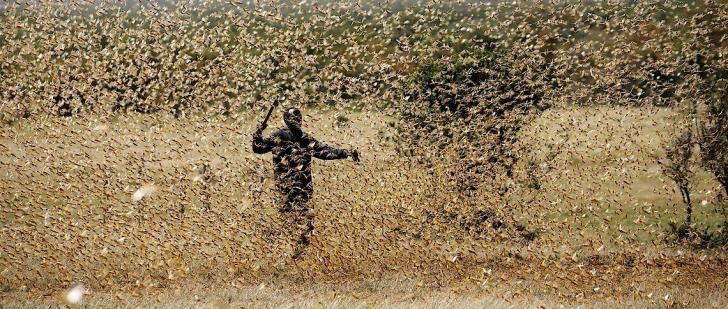
Farmers in Hwange District are counting heavy losses after a locust outbreak wiped out young crops across several wards, compounding an already difficult farming season marked by stalk borer infestations and destructive thunderstorms.
Kachechete Ward councillor Given Moyo said the season had started on a promising note following good rains, but hopes were quickly dashed when swarms of locusts descended on fields.
"The rains started well and people planted in their fields, but in the middle of this there was an outbreak of locusts that destroyed all the crops that were still about three weeks old," he said.
According to Moyo, farmers attempted to replant after the first wave of destruction, only for the pests to return and cause further damage.
"They replanted again and the same happened, especially in villages around Mpumelelo in BH25, Jengwe, BH9 and Chisuma from number one to four. These locusts wiped out everything, targeting small grains in particular, even upon germination," he said.
The situation has been worsened by a stalk borer outbreak and heavy thunderstorms that swept through parts of the district last week.
"We also have an outbreak of stalk borer, and what makes it even worse is that last week there were thunderstorms that also destroyed crops further in Jengwe, BH59 up to Chisuma number four. We are already afraid of the next drought because those who lost their crops to locusts have abandoned their fields, and it makes it difficult to even plan for the year," Moyo added.
In Jengwe village, one of the hardest-hit areas, women farmers say the repeated setbacks have left families increasingly vulnerable. Nomsa Ncube, a smallholder farmer, said she lost her entire three-week-old sorghum crop.
"We planted early when the rains came. The crop had just germinated and was looking healthy. Then the locusts came in large numbers and within days everything was gone," she said.
"We tried to replant, but again they came back. Now with the stalk borer and the heavy winds from last week's storms, we do not know if it is worth planting again. As women, we depend on these fields to feed our children."
In Chisuma, another affected area, Moline Dube described a season overwhelmed by multiple shocks.
"The small grains were targeted the most. Even the maize that survived is now affected by stalk borer. Then the thunderstorms destroyed the leaves, so even the remaining crops are weak," she said.
"If nothing changes, hunger will be serious this year. Some families have already stopped working in their fields because they feel discouraged."
The acting provincial director for the Agricultural Technical and Extension Services in Matabeleland North, Thulani Ndlovu, confirmed that Hwange was the only district in the province affected by the locust outbreak.
"Of the seven districts, Hwange was the only district affected by the locusts. We suspect that they may be coming from Zambia. The government came in and assisted with carbaryl chemicals for controlling the pests," he said.
However, Moyo said the chemicals arrived too late for many farmers, arguing that recovery is now nearly impossible for those who lost successive plantings.
Ndlovu said Agritex extension officers stationed at ward level were closely monitoring crop conditions and coordinating response measures.
"We have extension officers who are based at ward level. If there is any outbreak, they alert the district, province and national offices, and chemicals are accessed through the same process. After application, we also check chemical effectiveness and the level of crop damage," he said.
He urged farmers to promptly report any pest outbreaks to their Agritex ward officers to ensure swift intervention.
On the ground, however, farmers say time is running out. Repeated crop failures in a district already prone to erratic weather patterns are raising fears of worsening household food insecurity in the months ahead.
Kachechete Ward councillor Given Moyo said the season had started on a promising note following good rains, but hopes were quickly dashed when swarms of locusts descended on fields.
"The rains started well and people planted in their fields, but in the middle of this there was an outbreak of locusts that destroyed all the crops that were still about three weeks old," he said.
According to Moyo, farmers attempted to replant after the first wave of destruction, only for the pests to return and cause further damage.
"They replanted again and the same happened, especially in villages around Mpumelelo in BH25, Jengwe, BH9 and Chisuma from number one to four. These locusts wiped out everything, targeting small grains in particular, even upon germination," he said.
The situation has been worsened by a stalk borer outbreak and heavy thunderstorms that swept through parts of the district last week.
"We also have an outbreak of stalk borer, and what makes it even worse is that last week there were thunderstorms that also destroyed crops further in Jengwe, BH59 up to Chisuma number four. We are already afraid of the next drought because those who lost their crops to locusts have abandoned their fields, and it makes it difficult to even plan for the year," Moyo added.
In Jengwe village, one of the hardest-hit areas, women farmers say the repeated setbacks have left families increasingly vulnerable. Nomsa Ncube, a smallholder farmer, said she lost her entire three-week-old sorghum crop.
"We planted early when the rains came. The crop had just germinated and was looking healthy. Then the locusts came in large numbers and within days everything was gone," she said.
"We tried to replant, but again they came back. Now with the stalk borer and the heavy winds from last week's storms, we do not know if it is worth planting again. As women, we depend on these fields to feed our children."
"The small grains were targeted the most. Even the maize that survived is now affected by stalk borer. Then the thunderstorms destroyed the leaves, so even the remaining crops are weak," she said.
"If nothing changes, hunger will be serious this year. Some families have already stopped working in their fields because they feel discouraged."
The acting provincial director for the Agricultural Technical and Extension Services in Matabeleland North, Thulani Ndlovu, confirmed that Hwange was the only district in the province affected by the locust outbreak.
"Of the seven districts, Hwange was the only district affected by the locusts. We suspect that they may be coming from Zambia. The government came in and assisted with carbaryl chemicals for controlling the pests," he said.
However, Moyo said the chemicals arrived too late for many farmers, arguing that recovery is now nearly impossible for those who lost successive plantings.
Ndlovu said Agritex extension officers stationed at ward level were closely monitoring crop conditions and coordinating response measures.
"We have extension officers who are based at ward level. If there is any outbreak, they alert the district, province and national offices, and chemicals are accessed through the same process. After application, we also check chemical effectiveness and the level of crop damage," he said.
He urged farmers to promptly report any pest outbreaks to their Agritex ward officers to ensure swift intervention.
On the ground, however, farmers say time is running out. Repeated crop failures in a district already prone to erratic weather patterns are raising fears of worsening household food insecurity in the months ahead.
Source - Cite
Join the discussion
Loading comments…


