News / National
POTRAZ debunks claims of standalone Cyber Crimes Act
25 Jan 2026 at 14:19hrs |
0 Views
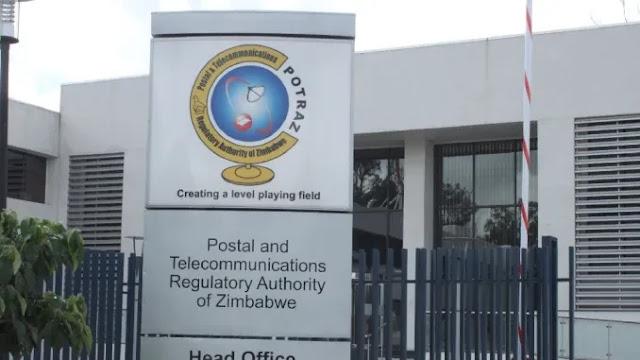
The Postal and Telecommunications Regulatory Authority of Zimbabwe (POTRAZ) has dismissed as false and misleading claims circulating on social media and some online platforms that Zimbabwe has enacted a standalone "Cyber Crimes Act."
In a public notice issued on Sunday, POTRAZ — in its capacity as the country's designated Data Protection Authority — clarified that Zimbabwe does not have an independent Cyber Crimes Act, but instead prosecutes cyber-related offences under existing legislation.
"POTRAZ… has noted with concern social media posts and online articles claiming that a ‘Cyber Crimes Act' has been enacted in Zimbabwe. This information is false and misleading," the authority said.
The regulator explained that cybercrime offences are provided for under the Criminal Law (Codification and Reform) Act [Chapter 9:23], commonly known as the Criminal Code. In 2021, the Criminal Code was strengthened through consequential amendments introduced by the Cyber and Data Protection Act [Chapter 12:07], in response to evolving technological developments.
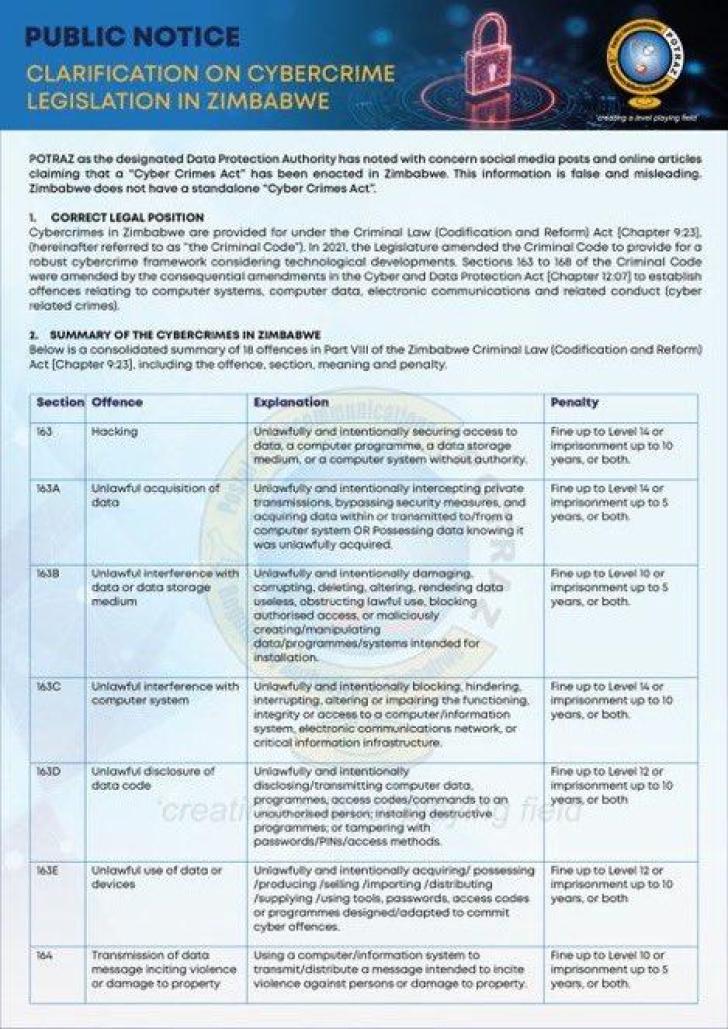
According to POTRAZ, Sections 163 to 168 of the Criminal Code were amended to establish offences relating to computer systems, computer data, electronic communications and related conduct. These provisions now cover a wide range of cyber-related crimes.
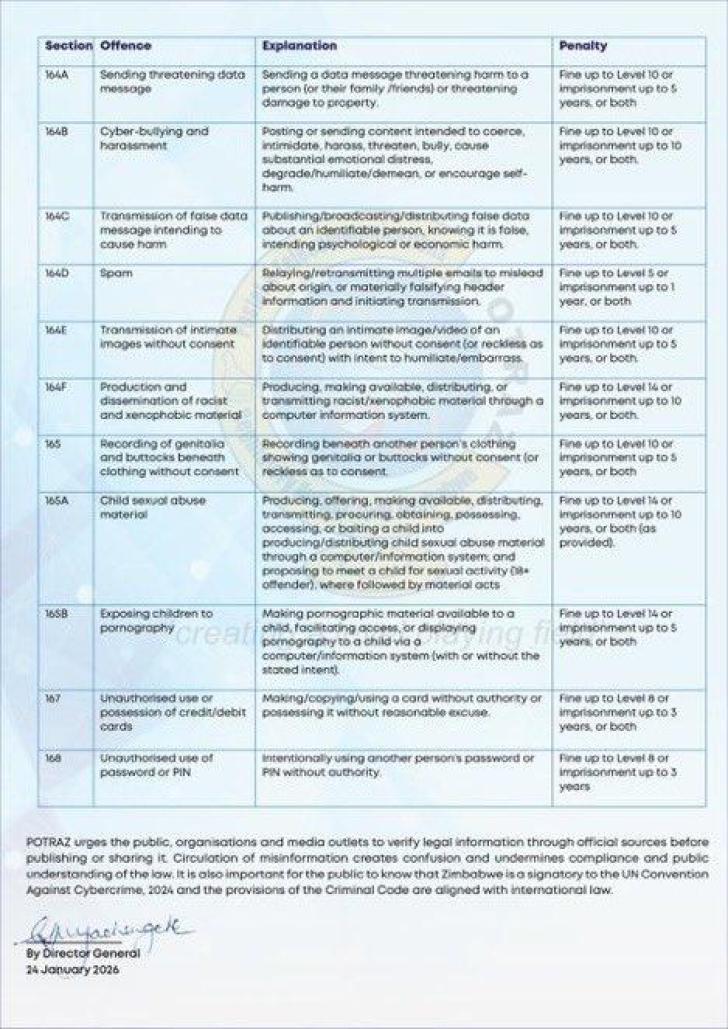
The offences include hacking, unlawful acquisition or interference with data and computer systems, unlawful disclosure of data codes, and the illegal use of devices or tools designed to commit cyber offences. The law also addresses cyberbullying and harassment, the transmission of threatening or false data messages, incitement to violence or property damage through electronic communications, and spam.
Additional offences include the transmission of intimate images without consent, recording intimate body parts without consent, and the production or dissemination of racist and xenophobic material through computer systems. Child protection provisions cover child sexual abuse material and exposing children to pornography via digital platforms.
Financial cybercrimes are also addressed, including the unauthorised use or possession of credit and debit cards, as well as the illegal use of another person's password or PIN. Penalties for these offences range from fines to imprisonment of up to 10 years, depending on the severity of the crime.
POTRAZ urged the public, organisations and media houses to verify legal information through official sources before publishing or sharing it, warning that misinformation undermines public understanding and compliance with the law.
The authority further noted that Zimbabwe is a signatory to the United Nations Convention Against Cybercrime (2024), and that the country's cybercrime provisions are aligned with international legal standards.
The clarification comes as Zimbabwe continues to strengthen its legal and regulatory framework to combat cyber threats while promoting responsible and lawful use of digital platforms.
In a public notice issued on Sunday, POTRAZ — in its capacity as the country's designated Data Protection Authority — clarified that Zimbabwe does not have an independent Cyber Crimes Act, but instead prosecutes cyber-related offences under existing legislation.
"POTRAZ… has noted with concern social media posts and online articles claiming that a ‘Cyber Crimes Act' has been enacted in Zimbabwe. This information is false and misleading," the authority said.
The regulator explained that cybercrime offences are provided for under the Criminal Law (Codification and Reform) Act [Chapter 9:23], commonly known as the Criminal Code. In 2021, the Criminal Code was strengthened through consequential amendments introduced by the Cyber and Data Protection Act [Chapter 12:07], in response to evolving technological developments.
According to POTRAZ, Sections 163 to 168 of the Criminal Code were amended to establish offences relating to computer systems, computer data, electronic communications and related conduct. These provisions now cover a wide range of cyber-related crimes.
The offences include hacking, unlawful acquisition or interference with data and computer systems, unlawful disclosure of data codes, and the illegal use of devices or tools designed to commit cyber offences. The law also addresses cyberbullying and harassment, the transmission of threatening or false data messages, incitement to violence or property damage through electronic communications, and spam.
Additional offences include the transmission of intimate images without consent, recording intimate body parts without consent, and the production or dissemination of racist and xenophobic material through computer systems. Child protection provisions cover child sexual abuse material and exposing children to pornography via digital platforms.
Financial cybercrimes are also addressed, including the unauthorised use or possession of credit and debit cards, as well as the illegal use of another person's password or PIN. Penalties for these offences range from fines to imprisonment of up to 10 years, depending on the severity of the crime.
POTRAZ urged the public, organisations and media houses to verify legal information through official sources before publishing or sharing it, warning that misinformation undermines public understanding and compliance with the law.
The authority further noted that Zimbabwe is a signatory to the United Nations Convention Against Cybercrime (2024), and that the country's cybercrime provisions are aligned with international legal standards.
The clarification comes as Zimbabwe continues to strengthen its legal and regulatory framework to combat cyber threats while promoting responsible and lawful use of digital platforms.
Source - online
Join the discussion
Loading comments…


