Opinion / Columnist
Could PV Sibanda emerge as Mnangagwa's successor?
2 hrs ago |
127 Views
If financial inducements are increasingly being used to manufacture political demonstrations of support, rather than merely sustain existing networks, the implications for succession politics would be significant.
It would suggest that visible expressions of factional strength may not always reflect genuine political allegiance.
Money could be influencing not only who receives support, but also how that support is displayed.
Under a system in which Parliament selects the President rather than the electorate doing so directly, the ability to cultivate and maintain political loyalties could become even more consequential.
This does not establish that parliamentary votes will be bought or that money will determine the succession.
It does mean that the relationship between wealth and political power must be treated as a central variable in the analysis.
Chiwenga, the military and the limits of historical precedent
Chiwenga remains central to the succession equation.
His role in the 2017 transition, his position as Vice-President and his historical connections to the security establishment make him impossible to ignore.
His Chinhoyi speech adds another dimension to the contest.
By emphasising accountability, collective leadership and the principle that political change should emerge through party structures, Chiwenga placed himself within a broader debate about the distribution and exercise of power in ZANU PF.
His remarks were not an explicit declaration of opposition to Mnangagwa, nor did they amount to a rejection of the conference resolutions.
But they should not be dismissed as routine conference rhetoric either.
The speech is consistent with several possible interpretations. Chiwenga may be seeking to preserve his political position within the existing arrangements. He may be signalling discomfort with the concentration of power around the incumbent. Alternatively, he may be laying the groundwork for a future contest over the party's leadership and succession.
The evidence does not yet allow us to determine which interpretation is correct.
What appears increasingly important is whether Mnangagwa considers Chiwenga a potential successor whose influence must be accommodated or a rival whose path to the presidency must be obstructed.
The distinction could shape the next phase of the contest.
The military dimension is equally important, but history must be treated carefully.
November 2017 demonstrated that factional competition within ZANU PF could converge with military intervention to produce a fundamental change in leadership.
However, 2017 is a reference point, not a blueprint for the present.
The configuration of the deep state has evolved, as have the relationships between political leaders, security institutions and powerful economic actors.
We cannot assume that the interests that shaped the 2017 transition remain unchanged or that the same actors would respond identically today.
Nor should the military be treated as a single, unified political actor. Institutional interests, personal relationships and competing calculations may influence how different constituencies within the security establishment respond.
The relevant question is not simply whether the military will intervene, but how the changing balance of power within the security establishment will affect the options available to competing political factions.
For now, there is insufficient public evidence to predict its response with confidence.
Could a dark horse emerge?
One weakness in much of the succession debate is the tendency to concentrate on Tagwirei and Chiwenga as though the eventual outcome must be a contest between the two.
That assumption may prove misplaced.
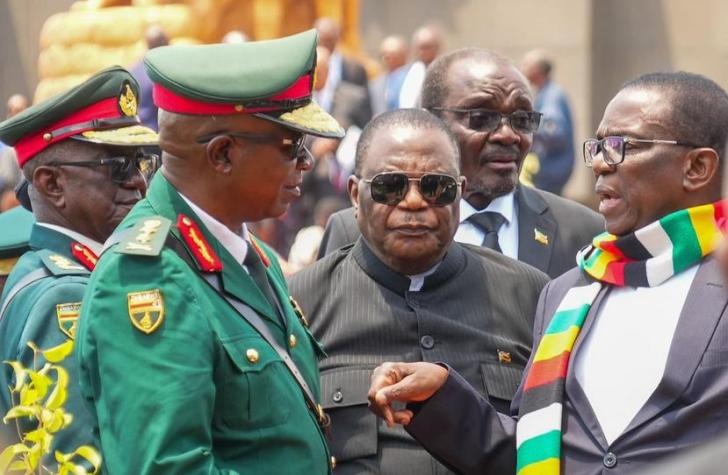
General Philip Valerio Sibanda, the former Commander of the Zimbabwe Defence Forces, is one potential dark-horse candidate worth examining.
Sibanda and Chiwenga share an important feature of their backgrounds: both served as commanders of the Zimbabwe Defence Forces.
Source - online
All articles and letters published on Bulawayo24 have been independently written by members of Bulawayo24's community. The views of users published on Bulawayo24 are therefore their own and do not necessarily represent the views of Bulawayo24. Bulawayo24 editors also reserve the right to edit or delete any and all comments received.
Join the discussion
Loading comments…