News / National
Mutsvangwa tells Chiwenga to quit ZANU PF if disgruntled
13 mins ago |
44 Views
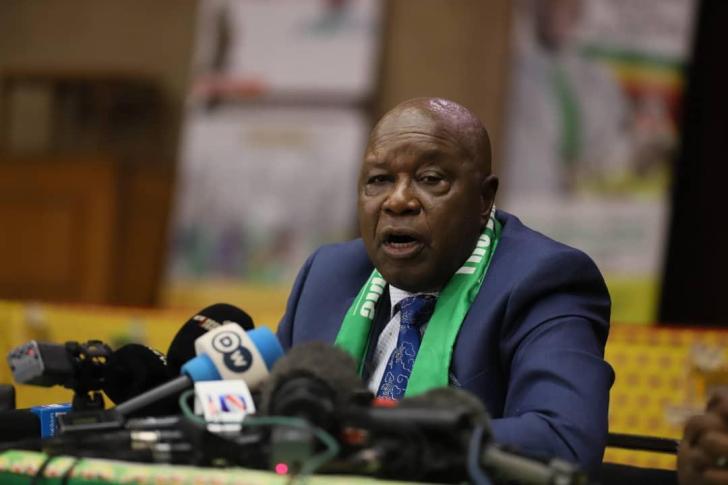
ZANU PF spokesperson Christopher Mutsvangwa has delivered a strongly worded warning to senior party officials challenging its political direction, declaring that those unwilling to accept collective decisions are free to leave the ruling party.
Speaking at the ZANU PF Masvingo Provincial Coordinating Committee (PCC) meeting on Sunday, Mutsvangwa appeared to take aim at Vice President Constantino Chiwenga following his controversial remarks at the party's Annual National People's Conference held in Chinhoyi last month.
Although Mutsvangwa did not mention Chiwenga by name, his comments were widely interpreted as a response to the Vice President's public questioning of the party's internal democratic processes and political direction.
At the October conference, Chiwenga challenged delegates to reflect on whether ZANU PF was repeating mistakes associated with the final years of former President Robert Mugabe's leadership.
He also questioned whether resolutions presented at the conference genuinely reflected the wishes of ordinary party members or were being driven by powerful individuals pursuing personal political interests.
Mutsvangwa, a prominent ally of President Emmerson Mnangagwa, argued that while internal debate was permitted, party members were expected to respect and implement resolutions once they had been adopted.
"In ZANU PF yes there is democracy but when we argue then after a resolution one decides to grandstand, going outside, we take issue with that," he said.
"After a resolution, we pursue what is called democratic centralism…it is leadership. But someone wanted to seek glory which you, who were delegates at the conference, denied him. He embarrassed himself."
Mutsvangwa insisted that ZANU PF's principle of democratic centralism required members to uphold decisions collectively, regardless of their personal positions during internal deliberations.
"Debate is welcome inside our structures, Central Committee, Politburo or even the Presidium, but once a decision is made, we move as one. That is ZANU PF and if you cannot toe the line leave," he declared.
His remarks reportedly drew applause from sections of the Masvingo provincial leadership attending the meeting.
The intervention comes against the backdrop of growing political tensions surrounding Mnangagwa's continued leadership and the succession question within ZANU PF.
Chiwenga, long regarded as a potential successor to Mnangagwa, has emerged as a prominent critic of aspects of the party's current direction.
Of particular concern is the political push to extend Mnangagwa's presidency to 2030, a development that has intensified debate over succession, constitutional governance and the balance of power within the ruling party.
The extension is associated with Constitutional Amendment Number 3, commonly referred to as CAB3, which has become a major point of contention among competing political interests.
Chiwenga's intervention at the Chinhoyi conference was widely viewed as a challenge to the political processes underpinning the 2030 agenda.
His criticism also touched on corruption, factionalism and the dangers of allowing individual political ambitions to override the interests of the party and the country.
By invoking the Mugabe era, Chiwenga appeared to warn against a return to practices that contributed to divisions within ZANU PF before the former President's removal from power in November 2017.
Mutsvangwa's response suggests that Mnangagwa's allies are increasingly unwilling to tolerate public criticism of resolutions already endorsed by party structures.
The spokesperson maintained that unity and discipline were essential as ZANU PF pursued its economic development programme and Vision 2030 objectives.
His remarks also reinforced the leadership's longstanding position that disagreements should be addressed through established party structures rather than public confrontation.
However, the exchange highlights a growing disagreement over the boundaries of internal democracy, particularly when senior leaders question decisions presented as the collective will of the party.
While Mutsvangwa insists that members must accept adopted resolutions, Chiwenga's earlier remarks raised questions about how those resolutions are formulated and whether grassroots members have meaningful influence over them.
The contrasting positions have sharpened attention on the relationship between Mnangagwa and his deputy, whose political futures remain closely tied to the party's succession arrangements.
With the 2030 agenda continuing to dominate internal political discussions, Mutsvangwa's warning signals a tougher approach towards dissent within the ruling party.
Source - NewZimbabwe
Join the discussion
Loading comments…





