News / National
Mnangagwa's railway revamp deal balloons from US$533m to US$3bn
05 Dec 2025 at 15:50hrs |
0 Views
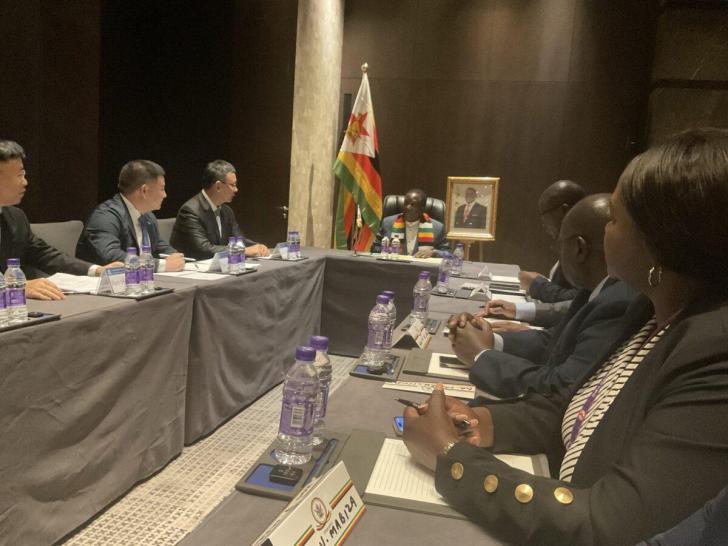
A major variance has emerged between Zimbabwe's earlier stated railway rehabilitation cost and the latest government figures, with a programme initially presented as a US$533 million investment now reflected in national policy documents as a US$3 billion overhaul under the National Development Strategy 2 (NDS2) framework.
Finance Minister Mthuli Ncube first cited the US$533 million figure in September 2025 when outlining infrastructure priorities, though details surrounding funding sources were unclear. At the time, the project was believed to hinge largely on Chinese loans and contractor-financed arrangements - a model that risked deepening Zimbabwe's debt exposure.
However, the latest NDS2 blueprint now presents the rail deal as a far larger undertaking, projected at around US$3 billion and spanning 2026 to 2030. The shift represents an almost six-fold escalation from the initial publicised figure and signals a significant expansion in scope, financing architecture, and projected outputs.
Where the original position centred on a single funding line, government documents now point to a portfolio approach - a blend of public-private partnerships (PPPs), debt financing, and injections from strategic state vehicles such as the Mutapa Investment Fund. The transition suggests Zimbabwe's rail redevelopment has evolved from a limited upgrade to a near-complete restructuring of the national network.
Under the revised rail roadmap, the largest allocation - estimated at US$1.2 billion - will finance the upgrade of the Mutare-Harare-Chirundu corridor and construction of a new 217km Lion's Den-Kafue line, strengthening north-south trade and SADC integration.
Another US$550 million is earmarked for a new heavy-haul industrial line servicing the Manhize steel complex, while US$480 million will rehabilitate 1 700km of existing track. The projects are expected to lift freight capacity, boost export competitiveness and shorten haulage times across major mining and manufacturing routes.
Locomotive and rolling stock acquisition also forms a substantial share of the modernisation plan, with US$210 million to be spent on 30 mainline locomotives and US$120 million for 841 new wagons alongside refurbishment of 1 000 older units. Signalling, telecommunications upgrades, bridge rehabilitation, passenger coach renewal and Wi-Fi-equipped Diesel Multiple Units add another several hundred million dollars to the total spend.
The programme also revives the previously abandoned Harare-Dabuka electrified section - shut down in 2009 following theft, grid instability and maintenance collapse. Re-electrification is expected to cut running costs, increase tonnage movement and modernise the backbone of the network.
The new cost band raises questions about what triggered the leap in valuation within just over a year — whether additional lines were added, scope widened, or inflation and financing structures recalculated.
The difference is stark: what was once presented as a mid-range infrastructure project now aligns with mega-investment scale, positioning the NRZ as a centrepiece of the NDS2 economic recovery model.
Government maintains the transformation is necessary, calling rail the lifeblood of mining and heavy industry. Coal producers in Hwange, among other private operators, are now expected to co-fund corridor rehabilitation to restore haulage capacity lost over two decades of decline.
The coming months will be critical. As contracts are negotiated and financing commitments tested, scrutiny will intensify - particularly around debt exposure, transparency and delivery capacity. Whether Zimbabwe will secure the full US$3 billion and implement it within five years may prove the true measure of this ambitious re-statement of intent.
Finance Minister Mthuli Ncube first cited the US$533 million figure in September 2025 when outlining infrastructure priorities, though details surrounding funding sources were unclear. At the time, the project was believed to hinge largely on Chinese loans and contractor-financed arrangements - a model that risked deepening Zimbabwe's debt exposure.
However, the latest NDS2 blueprint now presents the rail deal as a far larger undertaking, projected at around US$3 billion and spanning 2026 to 2030. The shift represents an almost six-fold escalation from the initial publicised figure and signals a significant expansion in scope, financing architecture, and projected outputs.
Where the original position centred on a single funding line, government documents now point to a portfolio approach - a blend of public-private partnerships (PPPs), debt financing, and injections from strategic state vehicles such as the Mutapa Investment Fund. The transition suggests Zimbabwe's rail redevelopment has evolved from a limited upgrade to a near-complete restructuring of the national network.
Under the revised rail roadmap, the largest allocation - estimated at US$1.2 billion - will finance the upgrade of the Mutare-Harare-Chirundu corridor and construction of a new 217km Lion's Den-Kafue line, strengthening north-south trade and SADC integration.
Another US$550 million is earmarked for a new heavy-haul industrial line servicing the Manhize steel complex, while US$480 million will rehabilitate 1 700km of existing track. The projects are expected to lift freight capacity, boost export competitiveness and shorten haulage times across major mining and manufacturing routes.
The programme also revives the previously abandoned Harare-Dabuka electrified section - shut down in 2009 following theft, grid instability and maintenance collapse. Re-electrification is expected to cut running costs, increase tonnage movement and modernise the backbone of the network.
The new cost band raises questions about what triggered the leap in valuation within just over a year — whether additional lines were added, scope widened, or inflation and financing structures recalculated.
The difference is stark: what was once presented as a mid-range infrastructure project now aligns with mega-investment scale, positioning the NRZ as a centrepiece of the NDS2 economic recovery model.
Government maintains the transformation is necessary, calling rail the lifeblood of mining and heavy industry. Coal producers in Hwange, among other private operators, are now expected to co-fund corridor rehabilitation to restore haulage capacity lost over two decades of decline.
The coming months will be critical. As contracts are negotiated and financing commitments tested, scrutiny will intensify - particularly around debt exposure, transparency and delivery capacity. Whether Zimbabwe will secure the full US$3 billion and implement it within five years may prove the true measure of this ambitious re-statement of intent.
Source - Byo24News
Join the discussion
Loading comments…





