News / National
Stop chasing spaza shops, take back the mines, says Malema
15 Jun 2026 at 21:07hrs |
0 Views
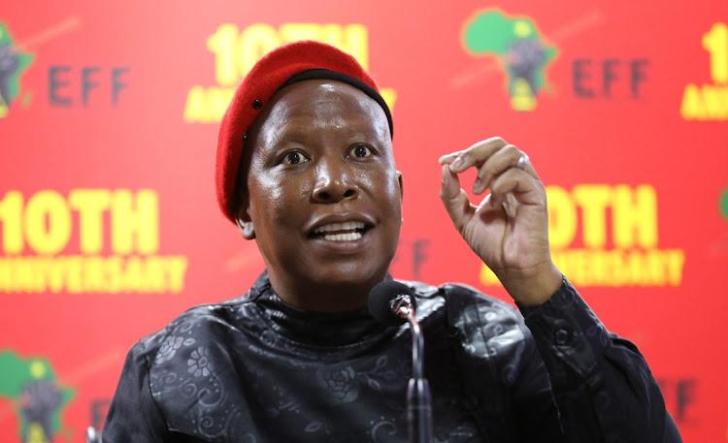
Economic Freedom Fighters (EFF) president Julius Malema has urged South Africans to focus on broader economic transformation rather than directing anger at foreign nationals operating spaza shops, arguing that the real struggle lies in ownership of key sectors of the economy.
Speaking at the funeral service of uMkhonto weSizwe (MK) Party parliamentary deputy chief whip Mzikayise Ntshingila on Sunday, Malema questioned why public mobilisation was largely centred on township retail businesses while strategic industries such as mining remained under the control of a relatively small group of owners.
"Why is there a strike to fight for spaza shops, but there is no strike to block the roads and claim the mines?" Malema asked. "These people who are mining here are the same as those that own spaza shops; they are not from here."
The EFF leader argued that the country's strategic means of production should be returned to what he described as their rightful owners, insisting that debates around economic justice should focus on larger structural issues rather than targeting small-scale traders.
"Let the mines, the strategic means of production, be returned into the hands of the rightful owners," he said.
Malema also suggested that international powers had shown little concern about tensions surrounding migration and xenophobia in South Africa because the disputes did not directly affect their economic interests.
He claimed that South Africans were being distracted by internal divisions while broader questions of economic control and ownership remained unresolved.
"There is no international response. We are concentrating on each other; they are making us lose the bigger picture," he said.
His remarks come amid heightened debate over immigration, foreign-owned businesses and economic inequality in South Africa, with several communities staging protests over the presence of undocumented migrants and foreign traders.
Malema maintained that economic transformation should prioritise those most disadvantaged by the legacy of colonialism and apartheid, particularly African workers and women.
"African working class and the white working class are not of the same status. We ought to emphasise the African working class because their situation is worse. We ought to emphasise women because their situation is worse," he said.
He stressed that advocating for redress and economic justice did not amount to hostility towards other racial or ethnic groups.
"It doesn't mean we hate coloureds, but coloureds are us, but their conditions were not the same as ours. It doesn't mean we hate Indians, but their conditions were not the same as ours," he said.
Malema further called for unity among Africans across the continent and in the diaspora, warning that divisions within the working class weakened efforts to achieve meaningful economic transformation.
"We were never taught the politics of hate, and we will never start hating now. We love all South Africans, Africans in particular, both in South Africa, Africa and in the diaspora," he said.
He added that Ntshingila's passing should serve as a moment of reflection and unity, highlighting the late legislator's contribution to parliamentary cooperation and the formation of the Progressive Caucus Charter.
The comments are likely to fuel ongoing debate over South Africa's approach to immigration, economic reform and ownership of strategic industries, issues that remain at the centre of the country's political discourse.
Speaking at the funeral service of uMkhonto weSizwe (MK) Party parliamentary deputy chief whip Mzikayise Ntshingila on Sunday, Malema questioned why public mobilisation was largely centred on township retail businesses while strategic industries such as mining remained under the control of a relatively small group of owners.
"Why is there a strike to fight for spaza shops, but there is no strike to block the roads and claim the mines?" Malema asked. "These people who are mining here are the same as those that own spaza shops; they are not from here."
The EFF leader argued that the country's strategic means of production should be returned to what he described as their rightful owners, insisting that debates around economic justice should focus on larger structural issues rather than targeting small-scale traders.
"Let the mines, the strategic means of production, be returned into the hands of the rightful owners," he said.
Malema also suggested that international powers had shown little concern about tensions surrounding migration and xenophobia in South Africa because the disputes did not directly affect their economic interests.
He claimed that South Africans were being distracted by internal divisions while broader questions of economic control and ownership remained unresolved.
"There is no international response. We are concentrating on each other; they are making us lose the bigger picture," he said.
His remarks come amid heightened debate over immigration, foreign-owned businesses and economic inequality in South Africa, with several communities staging protests over the presence of undocumented migrants and foreign traders.
Malema maintained that economic transformation should prioritise those most disadvantaged by the legacy of colonialism and apartheid, particularly African workers and women.
"African working class and the white working class are not of the same status. We ought to emphasise the African working class because their situation is worse. We ought to emphasise women because their situation is worse," he said.
He stressed that advocating for redress and economic justice did not amount to hostility towards other racial or ethnic groups.
"It doesn't mean we hate coloureds, but coloureds are us, but their conditions were not the same as ours. It doesn't mean we hate Indians, but their conditions were not the same as ours," he said.
Malema further called for unity among Africans across the continent and in the diaspora, warning that divisions within the working class weakened efforts to achieve meaningful economic transformation.
"We were never taught the politics of hate, and we will never start hating now. We love all South Africans, Africans in particular, both in South Africa, Africa and in the diaspora," he said.
He added that Ntshingila's passing should serve as a moment of reflection and unity, highlighting the late legislator's contribution to parliamentary cooperation and the formation of the Progressive Caucus Charter.
The comments are likely to fuel ongoing debate over South Africa's approach to immigration, economic reform and ownership of strategic industries, issues that remain at the centre of the country's political discourse.
Source - iol
Join the discussion
Loading comments…


