News / National
Zimbabweans top list of foreign academics at SA Universities
10 Jun 2026 at 12:08hrs |
0 Views
Zimbabwean and Nigerian nationals make up the largest share of foreign academics employed at South Africa's public universities, according to data submitted to Parliament amid growing scrutiny of hiring practices in the higher education sector.
The information was compiled following a directive issued by Parliament's Portfolio Committee on Higher Education and Training, chaired by Tebogo Letsie, which instructed public higher education institutions to provide detailed records of foreign academic staff by March 18, 2026.
The committee's request came in response to whistleblower reports and public allegations that foreign nationals were being favoured in recruitment and promotion processes over suitably qualified South African citizens.
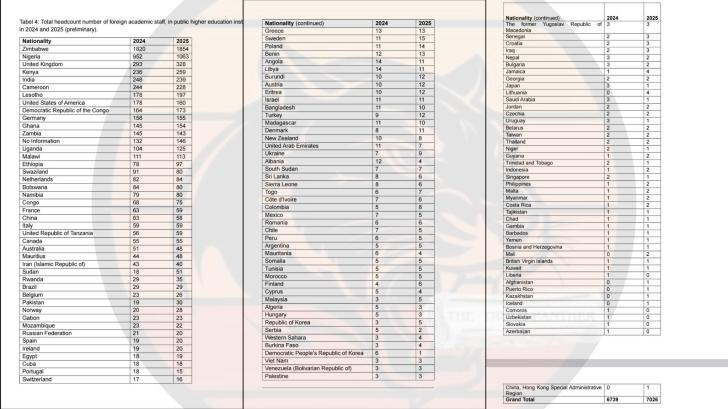
According to documents obtained by The Truth Panther, an analysis of staffing data from public universities shows that foreign academics accounted for 6,739 employees in 2024, based on audited Higher Education Management Information System (HEMIS) figures. Preliminary data for 2025 indicates the number has risen to 7,026.
Zimbabwean academics constitute the largest group, accounting for approximately 27 percent of all foreign academic staff employed at public universities. Based on the 2025 figures, this translates to more than 1,800 academics.
Nigerian nationals make up the second-largest group, representing about 14 percent of foreign academic staff, equivalent to more than 900 academics.
The data also shows significant representation from several other countries across Africa and beyond, including academics from India, United Kingdom, United States, Germany and China.
The disclosure has reignited debate over employment practices within South Africa's higher education sector, with some stakeholders arguing that universities should prioritise the recruitment and advancement of South African academics, particularly in light of high unemployment levels among graduates and professionals.
Others have defended the internationalisation of higher education institutions, arguing that universities benefit from attracting talent from across the continent and the world. They contend that academic appointments should continue to be based on qualifications, expertise and research output rather than nationality.
The Portfolio Committee is expected to examine the data as part of its oversight role and assess whether current recruitment practices comply with national employment and transformation objectives.
Universities have previously maintained that academic appointments are made through competitive recruitment processes aimed at attracting the best-qualified candidates, while also balancing transformation targets and institutional needs.
The findings are likely to feature prominently in ongoing discussions about skills shortages, transformation, employment equity and the role of international academics in South Africa's higher education system.
The information was compiled following a directive issued by Parliament's Portfolio Committee on Higher Education and Training, chaired by Tebogo Letsie, which instructed public higher education institutions to provide detailed records of foreign academic staff by March 18, 2026.
The committee's request came in response to whistleblower reports and public allegations that foreign nationals were being favoured in recruitment and promotion processes over suitably qualified South African citizens.
According to documents obtained by The Truth Panther, an analysis of staffing data from public universities shows that foreign academics accounted for 6,739 employees in 2024, based on audited Higher Education Management Information System (HEMIS) figures. Preliminary data for 2025 indicates the number has risen to 7,026.
Zimbabwean academics constitute the largest group, accounting for approximately 27 percent of all foreign academic staff employed at public universities. Based on the 2025 figures, this translates to more than 1,800 academics.
Nigerian nationals make up the second-largest group, representing about 14 percent of foreign academic staff, equivalent to more than 900 academics.
The data also shows significant representation from several other countries across Africa and beyond, including academics from India, United Kingdom, United States, Germany and China.
The disclosure has reignited debate over employment practices within South Africa's higher education sector, with some stakeholders arguing that universities should prioritise the recruitment and advancement of South African academics, particularly in light of high unemployment levels among graduates and professionals.
Others have defended the internationalisation of higher education institutions, arguing that universities benefit from attracting talent from across the continent and the world. They contend that academic appointments should continue to be based on qualifications, expertise and research output rather than nationality.
The Portfolio Committee is expected to examine the data as part of its oversight role and assess whether current recruitment practices comply with national employment and transformation objectives.
Universities have previously maintained that academic appointments are made through competitive recruitment processes aimed at attracting the best-qualified candidates, while also balancing transformation targets and institutional needs.
The findings are likely to feature prominently in ongoing discussions about skills shortages, transformation, employment equity and the role of international academics in South Africa's higher education system.
Source - Byo24News
Join the discussion
Loading comments…





