News / Local
Spectacular solar halo over Bulawayo sparks social media excitement
2 mins ago |
10 Views
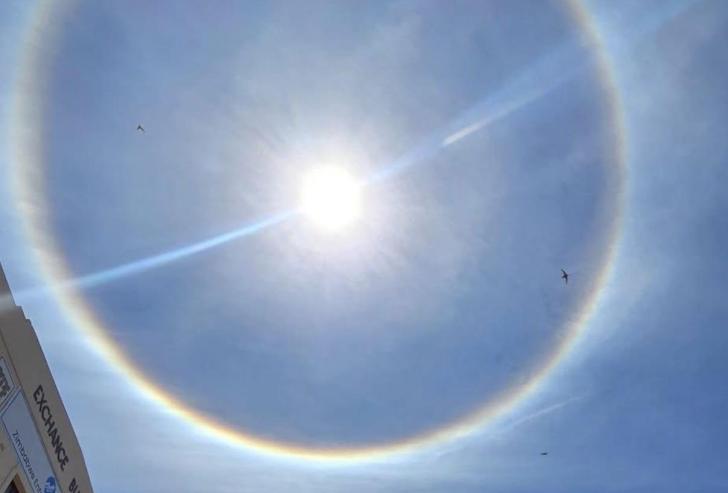
Bulawayo residents on Thursday were treated to a spectacular natural phenomenon after a massive ring of light appeared around the sun, prompting widespread excitement and a flood of photographs on social media.
The unusual spectacle, known as a 22-degree solar halo, attracted considerable attention as residents across the city captured images of the glowing circular formation surrounding the sun.
Photographs and videos of the phenomenon were widely shared on social media platforms, with many people expressing fascination at the striking appearance of the sky.
The images showed a nearly perfect ring encircling the sun, with faint rainbow-like colours visible along its edges.
ZBC News Online was among those who shared photographs of the phenomenon, describing it as a rare optical spectacle witnessed in Bulawayo.
The extraordinary display quickly became a talking point online as residents shared their own pictures of the luminous ring.
Despite its unusual appearance, the phenomenon has a straightforward scientific explanation.
A solar halo forms when sunlight passes through tiny hexagonal ice crystals suspended in high-altitude clouds, particularly cirrus and cirrostratus clouds.
As sunlight enters and exits these crystals, it bends through a process known as refraction, producing a circular ring around the sun at an angular distance of approximately 22 degrees.
The ice crystals effectively act as millions of tiny prisms, redirecting sunlight and creating the distinctive halo.
Unlike ordinary rainbows, which form when sunlight interacts with water droplets, solar halos are produced by ice crystals high in the atmosphere.
The inner edge of the halo often appears reddish, while the outer edge may display faint blue or violet colours.
Although the phenomenon can appear mysterious, solar halos are natural atmospheric optical events that can occur anywhere in the world when suitable conditions are present.
Their visibility depends on the presence of ice crystals in high-altitude clouds and the position of the sun relative to the observer.
Meteorologists say solar halos can sometimes indicate the presence of approaching weather systems, particularly when high-altitude clouds precede changes in atmospheric conditions.
However, the appearance of a halo does not necessarily mean that rain or a storm is imminent.
The phenomenon itself poses no danger to people on the ground, although looking directly at the sun while observing or photographing it can cause serious eye damage.
For Bulawayo residents, the striking display provided an opportunity to witness one of nature’s most fascinating atmospheric phenomena.
The widespread sharing of photographs on social media also allowed people who missed the spectacle to appreciate the remarkable sight.
While solar halos are not exceptionally rare worldwide, their dramatic appearance can make them memorable events, particularly when a clearly defined ring forms around the sun.
The Bulawayo sighting once again demonstrated how natural atmospheric conditions can produce breathtaking displays in the daytime sky.
Source - Byo24News
Join the discussion
Loading comments…