Business / Local
Finance Minister rallies governance leaders towards prosperity
2 hrs ago |
59 Views
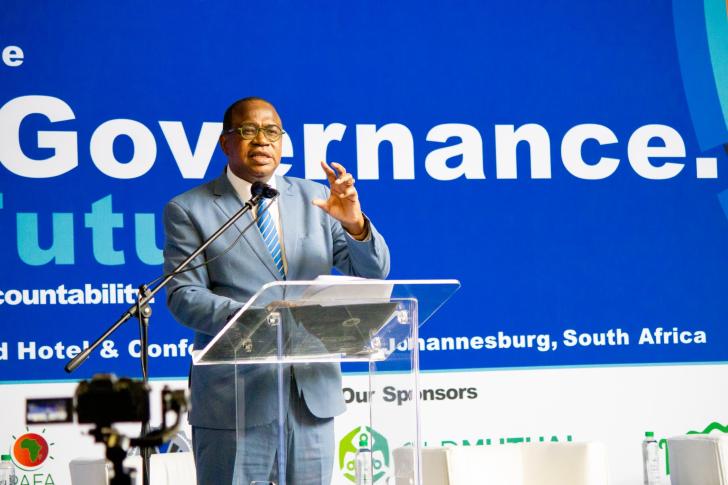
The Minister of Finance, Professor Mthuli Ncube, addressed the Chartered Governance and Accountancy Institute in Zimbabwe (CGAIZ) annual conference on Friday (October 9) with a stirring speech at the Birchwood Hotel and Conference Centre in Boksburg, South Africa.
Speaking to governance leaders, regulators, corporate executives and development partners, Professor Ncube declared that the country’s recent economic stability must now be translated into accelerated production, modern infrastructure, sustainable employment and elevated living standards for every citizen.
“It is a profound honour and privilege to join you today at the 2026 annual conference of the Chartered Governance and Accountancy Institute in Zimbabwe.
“This is a very important national assembly, which brings together governance and accounting leaders, regulators, policymakers, corporate executives and development partners to deliberate on matters that are key to Zimbabwe’s economic transformation.”
Anchoring his remarks on the conference theme ‘Better Governance, Better Future’, he described it as both timely and essential.
“National aspirations do not self‑execute. They materialise only when anchored by capable institutions, disciplined economic stewardship, ethical leadership and relentless execution. You will agree with me that an architect translates an abstract vision into a structural reality.
“Before breaking ground, the architect examines the foundation, selects resilient materials, assesses environmental risks and designs with the end‑user in mind. In precisely the same manner, governance and accountancy professionals translate national policies and corporate strategies into durable operational systems.”
Turning to the economy, Professor Ncube highlighted Zimbabwe’s resilience in the face of domestic and external shocks.
“The economy has demonstrated remarkable resilience, navigating successive domestic and external headwinds,” he said.
He noted that accelerated growth in 2025, propelled by mining, favourable commodity cycles, and a strong agricultural recovery, had spilled into 2026.
“Fiscal and monetary discipline have, in turn, fostered price and exchange‑rate stability, whilst local‑currency inflation was moderated significantly through the first half of 2026,” he added.
Professor Ncube underscored international recognition of these gains, citing the IMF’s August 2026 review acknowledging stabilisation, low inflation and a robust current account balance.
He also referenced the World Bank’s September 2026 Zimbabwe Growth and Jobs Report, which noted real economic growth averaging nearly 6% annually between 2021 and 2025.
Government revenues, he said, had risen from $3 billion in 2018 to $11 billion in 2026, with projected inflows of $20 billion by year‑end.
“That shows you that you can only collect so much revenue as government from a robust economy, from the work that you do as professionals out there to keep our economy going.”
He outlined the pillars of the National Development Strategy 2 (2026‑2030), including fiscal buffers and debt resolution, critical infrastructure, value addition and beneficiation and SME integration. He urged a shift from an expenditure culture to a performance culture.
“It is the people’s mandate. This is why your professions are directly linked to national development.”
The Minister praised progress on implementing accrual‑based International Public Sector Accounting Standards, noting their importance for visibility over public assets, liabilities and long‑term commitments. He commended CGAIZ’s efforts with the African Professionalisation Initiative to build capacity in data analytics, automation and public financial management.
On audits and oversight, Professor Ncube was emphatic saying when a major audit finding recurs annually, it ceases to be an accounting irregularity, it becomes a failure of board and executive accountability.
“Weak performance in state‑owned enterprises imposes a tax on the entire private sector; strong performance unlocks national productivity.”
He also addressed sustainability and technology noting that sustainability reporting cannot be treated as a greenwashed public‑relations exercise. Investors demand credible, verified data on environmental resilience, carbon impact and social governance.
In closing, Professor Ncube issued a direct challenge to governance professionals.
“Enforce absolute scrutiny, refuse to normalise failure and bridge capital to consequences through exercising your professional courage to ensure that financial allocations translate directly into visible, measurable outcomes for our citizens, communities and investors.
“Economic development is shaped not only in cabinet chambers or executive boardrooms. It is shaped in the daily decisions of individual professionals like you. You are the custodians of institutional trust.
“When governance improves, institutions perform. When accountability rises, public resources move further. When transparency takes root, investor confidence accelerates.
“Let us therefore join hands as Government, the private sector and the professions, consolidate the prevailing economic stability and together build a prosperous, inclusive and modern Zimbabwe,” he added.
Speaking to governance leaders, regulators, corporate executives and development partners, Professor Ncube declared that the country’s recent economic stability must now be translated into accelerated production, modern infrastructure, sustainable employment and elevated living standards for every citizen.
“It is a profound honour and privilege to join you today at the 2026 annual conference of the Chartered Governance and Accountancy Institute in Zimbabwe.
“This is a very important national assembly, which brings together governance and accounting leaders, regulators, policymakers, corporate executives and development partners to deliberate on matters that are key to Zimbabwe’s economic transformation.”
Anchoring his remarks on the conference theme ‘Better Governance, Better Future’, he described it as both timely and essential.
“National aspirations do not self‑execute. They materialise only when anchored by capable institutions, disciplined economic stewardship, ethical leadership and relentless execution. You will agree with me that an architect translates an abstract vision into a structural reality.
“Before breaking ground, the architect examines the foundation, selects resilient materials, assesses environmental risks and designs with the end‑user in mind. In precisely the same manner, governance and accountancy professionals translate national policies and corporate strategies into durable operational systems.”
Turning to the economy, Professor Ncube highlighted Zimbabwe’s resilience in the face of domestic and external shocks.
“The economy has demonstrated remarkable resilience, navigating successive domestic and external headwinds,” he said.
He noted that accelerated growth in 2025, propelled by mining, favourable commodity cycles, and a strong agricultural recovery, had spilled into 2026.
“Fiscal and monetary discipline have, in turn, fostered price and exchange‑rate stability, whilst local‑currency inflation was moderated significantly through the first half of 2026,” he added.
Professor Ncube underscored international recognition of these gains, citing the IMF’s August 2026 review acknowledging stabilisation, low inflation and a robust current account balance.
He also referenced the World Bank’s September 2026 Zimbabwe Growth and Jobs Report, which noted real economic growth averaging nearly 6% annually between 2021 and 2025.
“That shows you that you can only collect so much revenue as government from a robust economy, from the work that you do as professionals out there to keep our economy going.”
He outlined the pillars of the National Development Strategy 2 (2026‑2030), including fiscal buffers and debt resolution, critical infrastructure, value addition and beneficiation and SME integration. He urged a shift from an expenditure culture to a performance culture.
“It is the people’s mandate. This is why your professions are directly linked to national development.”
The Minister praised progress on implementing accrual‑based International Public Sector Accounting Standards, noting their importance for visibility over public assets, liabilities and long‑term commitments. He commended CGAIZ’s efforts with the African Professionalisation Initiative to build capacity in data analytics, automation and public financial management.
On audits and oversight, Professor Ncube was emphatic saying when a major audit finding recurs annually, it ceases to be an accounting irregularity, it becomes a failure of board and executive accountability.
“Weak performance in state‑owned enterprises imposes a tax on the entire private sector; strong performance unlocks national productivity.”
He also addressed sustainability and technology noting that sustainability reporting cannot be treated as a greenwashed public‑relations exercise. Investors demand credible, verified data on environmental resilience, carbon impact and social governance.
In closing, Professor Ncube issued a direct challenge to governance professionals.
“Enforce absolute scrutiny, refuse to normalise failure and bridge capital to consequences through exercising your professional courage to ensure that financial allocations translate directly into visible, measurable outcomes for our citizens, communities and investors.
“Economic development is shaped not only in cabinet chambers or executive boardrooms. It is shaped in the daily decisions of individual professionals like you. You are the custodians of institutional trust.
“When governance improves, institutions perform. When accountability rises, public resources move further. When transparency takes root, investor confidence accelerates.
“Let us therefore join hands as Government, the private sector and the professions, consolidate the prevailing economic stability and together build a prosperous, inclusive and modern Zimbabwe,” he added.
Source - Byo24News
Join the discussion
Loading comments…





