News / National
Zimbabwe issues 1.8 million e-passports, clears backlog
28 Feb 2026 at 14:23hrs |
0 Views
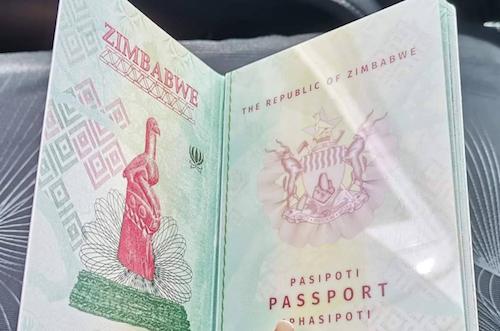
Government has issued nearly 1.8 million electronic passports since the programme's launch in January 2022, effectively clearing the long-standing backlog and accelerating the digitalisation of passport services.
Speaking during a tour of the e-passport centre by Special Advisor to the President on Monitoring Implementation of Government Programmes and Projects Dr Joram Gumbo, Civil Registry Department Registrar General Henry Machiri said the Harare Passport Centre alone has produced 897 042 e-passports since the rollout began.
Nationwide, a total of 1 797 760 e-passports have been issued, reflecting improved production capacity and growing public confidence in the new system.
The e-passport programme was officially launched by President Emmerson Mnangagwa on December 14, 2021, with issuance commencing on January 18, 2022. Harare became the first city to process and issue the new travel documents.
"To date, 1 797 760 e-passports have been issued countrywide. Harare Passport Centre alone has so far issued a total of 897 042 since the commencement of the programme," said Machiri. "The steady increase in processed applications demonstrates improved production capacity and growing public confidence in the new system."
The initiative forms part of broader public sector reforms aimed at enhancing service delivery through technology-driven systems. Authorities say the transition from machine-readable passports to electronic passports has significantly strengthened document security and reduced vulnerabilities to fraud.
Dr Gumbo described the shift as a major milestone in safeguarding national integrity, noting that the previous machine-readable passport system had weaknesses that could be exploited. He said the new e-passports are embedded with advanced biometric and encryption features that meet international standards, making tampering or duplication extremely difficult.
Processing times have also improved dramatically, with applications now taking approximately seven working days, down from as long as six months under the old system. Officials attribute the efficiency gains to a digital queuing and data capture system introduced as part of the reforms.
Speaking during a tour of the e-passport centre by Special Advisor to the President on Monitoring Implementation of Government Programmes and Projects Dr Joram Gumbo, Civil Registry Department Registrar General Henry Machiri said the Harare Passport Centre alone has produced 897 042 e-passports since the rollout began.
Nationwide, a total of 1 797 760 e-passports have been issued, reflecting improved production capacity and growing public confidence in the new system.
The e-passport programme was officially launched by President Emmerson Mnangagwa on December 14, 2021, with issuance commencing on January 18, 2022. Harare became the first city to process and issue the new travel documents.
"To date, 1 797 760 e-passports have been issued countrywide. Harare Passport Centre alone has so far issued a total of 897 042 since the commencement of the programme," said Machiri. "The steady increase in processed applications demonstrates improved production capacity and growing public confidence in the new system."
The initiative forms part of broader public sector reforms aimed at enhancing service delivery through technology-driven systems. Authorities say the transition from machine-readable passports to electronic passports has significantly strengthened document security and reduced vulnerabilities to fraud.
Dr Gumbo described the shift as a major milestone in safeguarding national integrity, noting that the previous machine-readable passport system had weaknesses that could be exploited. He said the new e-passports are embedded with advanced biometric and encryption features that meet international standards, making tampering or duplication extremely difficult.
Processing times have also improved dramatically, with applications now taking approximately seven working days, down from as long as six months under the old system. Officials attribute the efficiency gains to a digital queuing and data capture system introduced as part of the reforms.
Source - The Herald
Join the discussion
Loading comments…


