News / National
Zimbabwe targets record wheat harvest
17 Sep 2026 at 17:04hrs |
0 Views
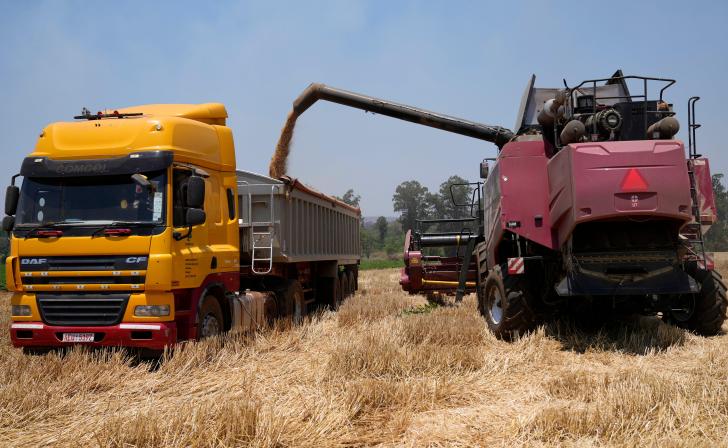
Zimbabwe has entered the 2026 winter wheat harvesting season with Government projecting a record harvest as farmers prepare to harvest more than 128 000 hectares planted under the crop.
Permanent Secretary in the Ministry of Lands, Agriculture, Fisheries, Water and Rural Development Obert Jiri toured Endbase Farm in Banket, Mashonaland West, where harvesting is already underway.
Government data shows that farmers planted 126 394 hectares of winter wheat, exceeding the national target of 125 000 hectares. Latest post-Cabinet figures have since put the planted area at 128 459 hectares, about three percent above the target.
The area under wheat has continued to expand over the past five years, rising from 78 063 hectares in 2022 to 90 186 hectares in 2023, 106 238 hectares in 2024 and 122 146 hectares in 2025.
Zimbabwe broke a 56-year-old wheat production record in 2022 after harvesting 375 000 tonnes and achieving wheat self-sufficiency for the first time.
Production subsequently increased to 467 905 tonnes in 2023, 518 502 tonnes in 2024 and a record 640 195 tonnes in 2025.
For the 2026 season, Government has set a production target of 662 500 tonnes. With annual national wheat consumption estimated at about 360 000 tonnes, the projected surplus of more than 300 000 tonnes is expected to strengthen the Strategic Grain Reserve.
To support the harvesting programme, 293 combine harvesters have been deployed and organised into wheat clusters, allowing machinery to be moved to districts where crops are ready for harvesting.
The programme is being coordinated by the Agricultural and Rural Development Advisory Services (ARDAS), Agritex and the Agricultural and Rural Development Authority (ARDA).
ARDA contributed 59 880 hectares to the wheat programme, representing about 92 percent of its target.
At Endbase Farm, the integrated farming model includes 100 hectares of wheat under harvest, with another 100 hectares being prepared for maize production during the summer season.
The farm is also baling wheat straw for livestock feed, supporting a herd of more than 400 cattle as well as other livestock farmers.
Jiri said harvesting would intensify in the coming weeks as more wheat reached the required moisture levels.
"Harvesting is expected to intensify over the next three to four weeks as more of the crop dries and becomes ready for combining. We have 293 combine harvesters that are active and organised into wheat clusters for deployment where the crop is ready," he said.
He also encouraged farmers to pursue value addition, including producing bread for their local communities.
The positive wheat outlook comes against the backdrop of concerns over the 2026/27 summer cropping season, with meteorological authorities warning of a heightened risk of El Niño conditions.
The Meteorological Services Department and the Global El Niño Southern Oscillation Analysis Cell have projected an 80 to 94 percent probability of El Niño developing between June and August 2026, with a 90 percent chance of the phenomenon persisting through November.
Historically, El Niño conditions have been associated with below-normal rainfall in Zimbabwe during the October-to-March rainy season.
The severe 2023/24 El Niño-induced drought left millions of Zimbabweans requiring food assistance and affected water supplies, livestock and grazing conditions.
In preparation for potential drought conditions, Government has outlined measures including strengthening grain reserves, expanding irrigation, promoting drought-tolerant crops such as sorghum and millet, increasing livestock feed production, improving water harvesting and strengthening early-warning systems.
Farmers have also been urged to guard against veld fires during the harvesting period.
Jiri urged farmers to maintain fireguards and firefighting teams while ensuring that wheat straw is quickly baled and removed from fields.
"As Zimbabwe prepares for anticipated El Niño conditions and drought risks, farmers must remain on high alert. They should maintain fireguards and fire-fighting gangs, bale wheat straw quickly and remove it from fields," he said.
"Wheat stover should not be burnt, it should be converted into stock feed. The message is harvest early, protect the crop, bale the stover, prepare for the next season and add value."
Permanent Secretary in the Ministry of Lands, Agriculture, Fisheries, Water and Rural Development Obert Jiri toured Endbase Farm in Banket, Mashonaland West, where harvesting is already underway.
Government data shows that farmers planted 126 394 hectares of winter wheat, exceeding the national target of 125 000 hectares. Latest post-Cabinet figures have since put the planted area at 128 459 hectares, about three percent above the target.
The area under wheat has continued to expand over the past five years, rising from 78 063 hectares in 2022 to 90 186 hectares in 2023, 106 238 hectares in 2024 and 122 146 hectares in 2025.
Zimbabwe broke a 56-year-old wheat production record in 2022 after harvesting 375 000 tonnes and achieving wheat self-sufficiency for the first time.
Production subsequently increased to 467 905 tonnes in 2023, 518 502 tonnes in 2024 and a record 640 195 tonnes in 2025.
For the 2026 season, Government has set a production target of 662 500 tonnes. With annual national wheat consumption estimated at about 360 000 tonnes, the projected surplus of more than 300 000 tonnes is expected to strengthen the Strategic Grain Reserve.
To support the harvesting programme, 293 combine harvesters have been deployed and organised into wheat clusters, allowing machinery to be moved to districts where crops are ready for harvesting.
The programme is being coordinated by the Agricultural and Rural Development Advisory Services (ARDAS), Agritex and the Agricultural and Rural Development Authority (ARDA).
ARDA contributed 59 880 hectares to the wheat programme, representing about 92 percent of its target.
At Endbase Farm, the integrated farming model includes 100 hectares of wheat under harvest, with another 100 hectares being prepared for maize production during the summer season.
The farm is also baling wheat straw for livestock feed, supporting a herd of more than 400 cattle as well as other livestock farmers.
"Harvesting is expected to intensify over the next three to four weeks as more of the crop dries and becomes ready for combining. We have 293 combine harvesters that are active and organised into wheat clusters for deployment where the crop is ready," he said.
He also encouraged farmers to pursue value addition, including producing bread for their local communities.
The positive wheat outlook comes against the backdrop of concerns over the 2026/27 summer cropping season, with meteorological authorities warning of a heightened risk of El Niño conditions.
The Meteorological Services Department and the Global El Niño Southern Oscillation Analysis Cell have projected an 80 to 94 percent probability of El Niño developing between June and August 2026, with a 90 percent chance of the phenomenon persisting through November.
Historically, El Niño conditions have been associated with below-normal rainfall in Zimbabwe during the October-to-March rainy season.
The severe 2023/24 El Niño-induced drought left millions of Zimbabweans requiring food assistance and affected water supplies, livestock and grazing conditions.
In preparation for potential drought conditions, Government has outlined measures including strengthening grain reserves, expanding irrigation, promoting drought-tolerant crops such as sorghum and millet, increasing livestock feed production, improving water harvesting and strengthening early-warning systems.
Farmers have also been urged to guard against veld fires during the harvesting period.
Jiri urged farmers to maintain fireguards and firefighting teams while ensuring that wheat straw is quickly baled and removed from fields.
"As Zimbabwe prepares for anticipated El Niño conditions and drought risks, farmers must remain on high alert. They should maintain fireguards and fire-fighting gangs, bale wheat straw quickly and remove it from fields," he said.
"Wheat stover should not be burnt, it should be converted into stock feed. The message is harvest early, protect the crop, bale the stover, prepare for the next season and add value."
Source - newsday
Join the discussion
Loading comments…


