News / National
Mnangagwa, UN challenge Africa to produce, not just train
2 hrs ago |
49 Views
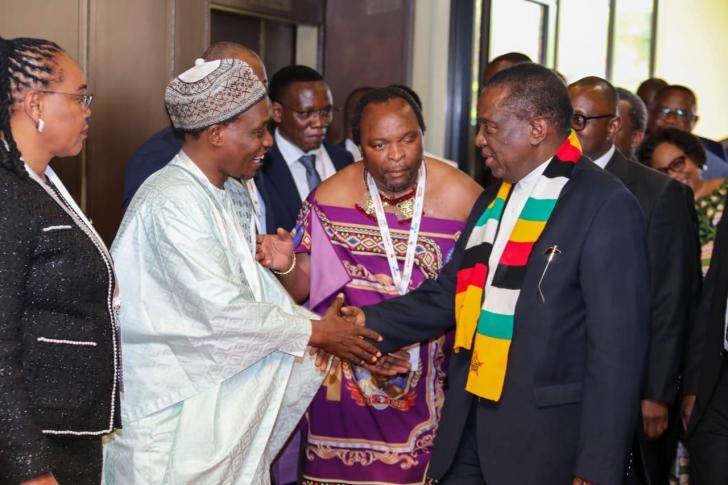
HARARE - President Emmerson Mnangagwa and the United Nations have challenged African countries to move beyond simply producing graduates and certificates and instead focus on transforming skills into productivity, jobs, industrial growth and retained wealth.
The call was made during the official opening of Africa Skills Week 2026 in Harare, a continental gathering attended by policymakers, parliamentarians, ministers, industry leaders and development partners from across Africa.
Held under the theme "Skills for Resilient and Competitive African Industries: From Training to Value Creation," the event marks the first time Zimbabwe has hosted the African Union's flagship skills development dialogue.
Opening the conference, President Mnangagwa described the theme as a timely call for Africa to rethink its approach to education and skills development.
"It is a decisive paradigm shift so that we transition from the culture of mere acquisition of theoretical education," he said.
"We all have a duty to embrace a bold new era where skills and appropriate capabilities propel value creation, industrial transformation and economic sovereignty."
The President said African countries must move from policy discussions to practical implementation by operationalising initiatives such as the Continental Education Strategy for Africa, the African Continental Technical and Vocational Education and Training (TVET) Strategy and the Fourth Industrial Development Decade for Africa.
He stressed that Africa's abundant natural resources alone would not guarantee prosperity.
"Africa's unmatched mineral wealth, vast tracts of arable land, rich biodiversity and immense energy potential will not generate sustainable wealth until its natural resources are combined with human skills and practical industrial capabilities," Mnangagwa said.
He added that the aspirations of Agenda 2063 could only be achieved through African-led development.
"Our continental vision under Agenda 2063 calls for an integrated, prosperous and peaceful Africa, driven by its own citizens. To realise the Africa We Want, development must be spearheaded by Africans. It cannot be outsourced or rely on external formulas."
With more than 60 percent of Africa's population under the age of 35, Mnangagwa said the continent's youthful population should become a competitive advantage through work-based learning, entrepreneurship and industrial development.
The President highlighted Zimbabwe's Heritage-Based Education 5.0 model, saying it has encouraged innovation, patents, commercialisation and industrial solutions.
He also warned that technological advances such as artificial intelligence, automation, robotics and digital transformation are reshaping labour markets and require new approaches to education and training.
Mnangagwa urged African governments to embed ICT and AI literacy throughout education systems while investing in software engineering, data analytics, precision manufacturing and automation-related skills.
He further called for investments in green skills linked to renewable energy, climate-smart agriculture, sustainable construction and the bio-economy.
United Nations Resident Coordinator Dr Rosemary Kalapurakal reinforced the President's message, cautioning that training alone is insufficient if it does not translate into economic opportunities.
"While education opens minds, skills open markets. The question is not how many people we train. It is whether investments in skills translate into greater productivity, stronger enterprises, decent jobs, innovation and higher value retained within African economies," she said.
Kalapurakal challenged governments to evaluate every skills programme against three key questions: whether it boosts productivity and competitiveness, increases value retention within Africa and creates pathways to decent employment.
She also argued that skills strategies must be closely linked to economic policies and industrial development plans.
"A mineral becomes a national asset not only when it is extracted, but also when its value chain creates skilled workers, competitive enterprises, innovation and decent jobs," she said.
The UN official commended Zimbabwe for establishing a standalone Ministry of Skills Audit and Development, describing the move as a strategic step towards aligning education with economic growth.
She reaffirmed UN support under the forthcoming 2027-2031 Cooperation Framework, which seeks to promote stronger links between training, employment and entrepreneurship in sectors such as agriculture, mining, manufacturing, agro-processing and the green economy.
Kalapurakal also warned that rapid technological change and climate-related challenges require countries to prioritise STEM education, entrepreneurship, lifelong learning and uniquely human capabilities such as creativity, judgement, adaptability and foresight.
Meanwhile, Skills Audit and Development Minister Dr Jenfan Muswere said the conference complements Zimbabwe's efforts to strengthen skills retention and address shortages identified through the country's National Skills Audit.
Africa Skills Week is expected to produce recommendations aimed at strengthening skills development, industrial competitiveness and economic transformation across the continent.
The call was made during the official opening of Africa Skills Week 2026 in Harare, a continental gathering attended by policymakers, parliamentarians, ministers, industry leaders and development partners from across Africa.
Held under the theme "Skills for Resilient and Competitive African Industries: From Training to Value Creation," the event marks the first time Zimbabwe has hosted the African Union's flagship skills development dialogue.
Opening the conference, President Mnangagwa described the theme as a timely call for Africa to rethink its approach to education and skills development.
"It is a decisive paradigm shift so that we transition from the culture of mere acquisition of theoretical education," he said.
"We all have a duty to embrace a bold new era where skills and appropriate capabilities propel value creation, industrial transformation and economic sovereignty."
The President said African countries must move from policy discussions to practical implementation by operationalising initiatives such as the Continental Education Strategy for Africa, the African Continental Technical and Vocational Education and Training (TVET) Strategy and the Fourth Industrial Development Decade for Africa.
He stressed that Africa's abundant natural resources alone would not guarantee prosperity.
"Africa's unmatched mineral wealth, vast tracts of arable land, rich biodiversity and immense energy potential will not generate sustainable wealth until its natural resources are combined with human skills and practical industrial capabilities," Mnangagwa said.
He added that the aspirations of Agenda 2063 could only be achieved through African-led development.
"Our continental vision under Agenda 2063 calls for an integrated, prosperous and peaceful Africa, driven by its own citizens. To realise the Africa We Want, development must be spearheaded by Africans. It cannot be outsourced or rely on external formulas."
With more than 60 percent of Africa's population under the age of 35, Mnangagwa said the continent's youthful population should become a competitive advantage through work-based learning, entrepreneurship and industrial development.
The President highlighted Zimbabwe's Heritage-Based Education 5.0 model, saying it has encouraged innovation, patents, commercialisation and industrial solutions.
He also warned that technological advances such as artificial intelligence, automation, robotics and digital transformation are reshaping labour markets and require new approaches to education and training.
Mnangagwa urged African governments to embed ICT and AI literacy throughout education systems while investing in software engineering, data analytics, precision manufacturing and automation-related skills.
He further called for investments in green skills linked to renewable energy, climate-smart agriculture, sustainable construction and the bio-economy.
United Nations Resident Coordinator Dr Rosemary Kalapurakal reinforced the President's message, cautioning that training alone is insufficient if it does not translate into economic opportunities.
"While education opens minds, skills open markets. The question is not how many people we train. It is whether investments in skills translate into greater productivity, stronger enterprises, decent jobs, innovation and higher value retained within African economies," she said.
Kalapurakal challenged governments to evaluate every skills programme against three key questions: whether it boosts productivity and competitiveness, increases value retention within Africa and creates pathways to decent employment.
She also argued that skills strategies must be closely linked to economic policies and industrial development plans.
"A mineral becomes a national asset not only when it is extracted, but also when its value chain creates skilled workers, competitive enterprises, innovation and decent jobs," she said.
The UN official commended Zimbabwe for establishing a standalone Ministry of Skills Audit and Development, describing the move as a strategic step towards aligning education with economic growth.
She reaffirmed UN support under the forthcoming 2027-2031 Cooperation Framework, which seeks to promote stronger links between training, employment and entrepreneurship in sectors such as agriculture, mining, manufacturing, agro-processing and the green economy.
Kalapurakal also warned that rapid technological change and climate-related challenges require countries to prioritise STEM education, entrepreneurship, lifelong learning and uniquely human capabilities such as creativity, judgement, adaptability and foresight.
Meanwhile, Skills Audit and Development Minister Dr Jenfan Muswere said the conference complements Zimbabwe's efforts to strengthen skills retention and address shortages identified through the country's National Skills Audit.
Africa Skills Week is expected to produce recommendations aimed at strengthening skills development, industrial competitiveness and economic transformation across the continent.
Source - Byo24News
Join the discussion
Loading comments…


