News / National
Another coup emerging in Zimbabwe?
27 Apr 2026 at 10:29hrs |
0 Views
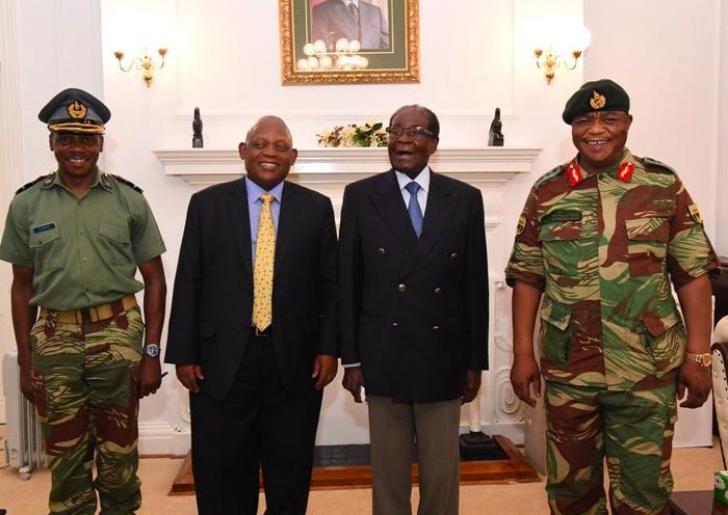
Prominent publisher Trevor Ncube has raised fresh concerns over Zimbabwe's political trajectory, warning that the country may be drifting toward conditions similar to those that led to the removal of former President Robert Mugabe in 2017.
In a recent social media post, Ncube said a new network of politically connected elites is emerging, wielding significant economic and political influence in ways that echo past power dynamics.
Ncube identified several business figures - including Kudakwashe Tagwirei, Paul Tungwarara, Scott Sakupwanya and Wicknell Chivayo - as part of what he described as a powerful and fast-rising elite group.
According to Ncube, their proximity to political power, coupled with rapid wealth accumulation, has fostered a sense of invincibility that risks undermining principles of accountability and transparency.
He warned that such concentration of influence could distort governance systems and deepen inequality.
Drawing historical parallels, Ncube likened current developments to the rise of the G40 faction, whose dominance in political circles preceded the 2017 Zimbabwe military coup.
That intervention marked a watershed moment, ending Mugabe's nearly four-decade rule and ushering in President Emmerson Mnangagwa.
Ncube cautioned that similar patterns of unchecked influence and political overconfidence, if left unchallenged, could once again destabilise the country.
Beyond elite politics, Ncube expressed concern over growing public frustration and diminishing faith in democratic institutions.
He warned that, in the absence of a strong and credible opposition, some citizens may begin to view the military as a fallback stabilising force — a development he described as deeply troubling.
"That is not a democracy," Ncube said, underscoring the risks of relying on non-civilian institutions to resolve political tensions.
Ncube's remarks come as Zimbabwe debates proposed constitutional amendments that could reshape the country's governance framework.
He urged both political leaders and citizens to reflect on recent history, warning that failure to learn from past mistakes could have far-reaching consequences.
With decades of experience in the media industry, Ncube remains an influential commentator on national affairs. He previously served as controlling shareholder of the Mail & Guardian Media Group between 2002 and 2017.
He now leads Alpha Media Holdings as founder and executive chairman, overseeing publications including NewsDay, the Zimbabwe Independent and The Standard.
His latest intervention adds momentum to an increasingly robust debate over Zimbabwe's political direction and the evolving balance of power within the state.
In a recent social media post, Ncube said a new network of politically connected elites is emerging, wielding significant economic and political influence in ways that echo past power dynamics.
Ncube identified several business figures - including Kudakwashe Tagwirei, Paul Tungwarara, Scott Sakupwanya and Wicknell Chivayo - as part of what he described as a powerful and fast-rising elite group.
According to Ncube, their proximity to political power, coupled with rapid wealth accumulation, has fostered a sense of invincibility that risks undermining principles of accountability and transparency.
He warned that such concentration of influence could distort governance systems and deepen inequality.
Drawing historical parallels, Ncube likened current developments to the rise of the G40 faction, whose dominance in political circles preceded the 2017 Zimbabwe military coup.
That intervention marked a watershed moment, ending Mugabe's nearly four-decade rule and ushering in President Emmerson Mnangagwa.
Ncube cautioned that similar patterns of unchecked influence and political overconfidence, if left unchallenged, could once again destabilise the country.
He warned that, in the absence of a strong and credible opposition, some citizens may begin to view the military as a fallback stabilising force — a development he described as deeply troubling.
"That is not a democracy," Ncube said, underscoring the risks of relying on non-civilian institutions to resolve political tensions.
Ncube's remarks come as Zimbabwe debates proposed constitutional amendments that could reshape the country's governance framework.
He urged both political leaders and citizens to reflect on recent history, warning that failure to learn from past mistakes could have far-reaching consequences.
With decades of experience in the media industry, Ncube remains an influential commentator on national affairs. He previously served as controlling shareholder of the Mail & Guardian Media Group between 2002 and 2017.
He now leads Alpha Media Holdings as founder and executive chairman, overseeing publications including NewsDay, the Zimbabwe Independent and The Standard.
His latest intervention adds momentum to an increasingly robust debate over Zimbabwe's political direction and the evolving balance of power within the state.
Source - The South African
Join the discussion
Loading comments…



