Opinion / Columnist
How can Chivayo justify his place in the President's delegation as a ‘businessman' yet couldn't even exhibit at the ZITF?
28 Apr 2026 at 20:34hrs |
0 Views
Zimbabwe has become the laughing stock of the world.
The spectacle witnessed at the 2026 Zimbabwe International Trade Fair (ZITF) was more than just a gathering of regional leaders and industry titans; it was a profound illustration of the shifting tectonic plates within the Zimbabwean state.
If you value my social justice advocacy and writing, please consider a financial contribution to keep it going. Contact me on WhatsApp: +263 715 667 700 or Email: mbofana.tendairuben73@gmail.com
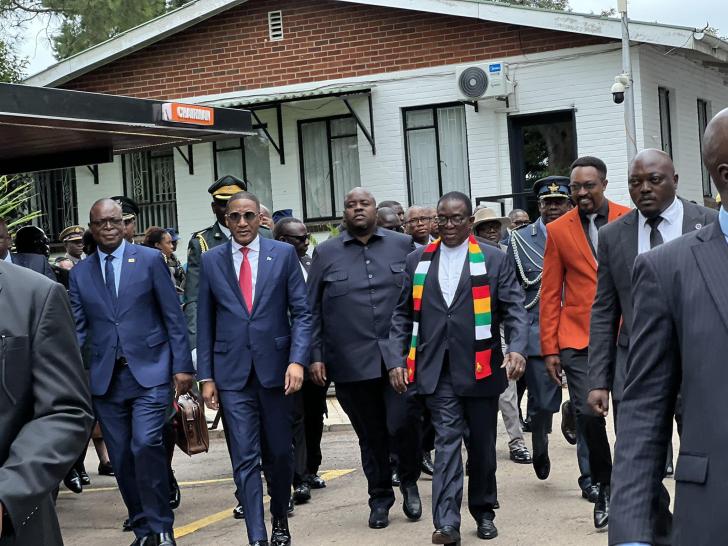
When Wicknell Chivayo, a man whose name is synonymous with the controversial intersection of public tenders and private luxury, was seen flanking President Emmerson Mnangagwa and Botswana's President Duma Boko, the imagery spoke volumes.
It was not merely a matter of a businessman attending a trade fair; it was a brazen assertion of an informal power structure that seeks to bypass, and ultimately replace, the formal institutions of governance.
Chivayo's subsequent social media rebuke of Bulawayo Mayor David Coltart serves as the manifesto for this new reality - a reality where proximity to the person of the President carries more weight than an electoral mandate, administrative protocol, or even the basic standards of corporate transparency.
To understand the gravity of Chivayo's claims, one must first dismantle his primary defense: the notion of "Presidential Prerogative."
Chivayo argues that the President has the absolute right to select his delegation based on the "value" they bring.
While a President may certainly consult with private citizens, the ZITF is a state function of the highest order.
When a President hosts a foreign head of state - particularly one like Duma Boko, who campaigned on a platform of institutional renewal—the "value" of the accompanying delegation must be measured by diplomatic standard and national integrity.
By elevating a private citizen with no official rank and a history of stalled national projects to the status of a de facto state official, the Presidency is signaling a retreat from institutionalism.
It suggests that the state is no longer a collection of rules and ministries, but a personal circle where access is granted based on loyalty rather than merit.
However, the most curious aspect of Chivayo's pushback against Mayor Coltart is his repeated insistence on his "vast business interests" across the continent.
He describes himself as a philanthropist and mogul with operations in South Africa, Tanzania, Kenya, and Uganda.
Yet, for an entrepreneur of such supposedly massive scale, there is a glaring, almost pathological lack of detail.
It is a striking anomaly in the Zimbabwean business landscape.
When one speaks of Strive Masiyiwa, his "vast interests" are tangible, audited, and visible across the global telecommunications and tech sectors.
Even among those Chivayo might consider his peers in the "tenderpreneur" class—figures like Kudakwashe Tagwirei or Paul Tungwarara—the business entities are identifiable, whether they involve fuel, mining, or large-scale construction.
Regardless of the controversies surrounding them, one can point to a physical footprint, a workforce, and a balance sheet.
In contrast, Chivayo's empire remains shrouded in a fog of social media posts and expensive car handovers.
If these business interests are as "vast" and legitimate as he claims, one is left to wonder why he is so eager to clear his name of controversy while simultaneously withholding the very evidence that would do so.
In the world of serious business, transparency is the ultimate currency.
There is nothing unusual or intrusive about asking a man who walks with Presidents to produce the financial statements of his various enterprises.
If he is a billionaire of international standing, where is the record of his industrial output?
Where are the thousands of employees one would expect from a conglomerate spanning five countries?
Are we to be faulted if we conclude that his only real claim to fortune lies in "special purpose vehicles" like Intratrek Zimbabwe, Intratrek South Africa, and IMC Communications?
These entities appear to have no unidentifiable business activities beyond the securing of highly inflated public tenders.
This "middleman" model—where a contract is secured, then subcontracted at a fraction of the cost to companies that actually possess the technical capacity—is not "vast business interest."
It is a rent-seeking exercise that leaves a handful of individuals with multi-million-dollar profits while the taxpayer is left with stalled projects and crumbling infrastructure.
The irony of Chivayo's presence at the ZITF is further sharpened by his failure to participate in the very event he used as a backdrop for his power play.
He describes himself as a business leader whose presence in a presidential delegation is the "norm the world over."
Yet, if he is such a titan of industry, why did none of his "vast businesses" actually exhibit at the trade fair?
The ZITF is the country's premier showpiece for business, a place where companies display their products, court investors, and demonstrate their contribution to the national economy.
To be part of an official delegation meeting a foreign head of state under the guise of representing "business" while failing to even host an exhibition stand is a staggering contradiction.
It reveals that Chivayo was not there to trade or to foster "public-private synergies," but to display his proximity to power.
He was an exhibit himself—a living testimonial to the fact that in the current era, having the right phone number is more important than having a competitive product.
When the cameras pan across the ZITF floor, they should see the President flanked by his deputies, his ministers, or leaders of recognized business chambers like the CZI or ZNCC.
Instead, the focus was pulled toward a "tenderpreneur" whose primary contribution to the public discourse is a stream of X posts showcasing high-end vehicles.
This is not "fostering public-private synergies," as Chivayo claims; it is the personalization of the state, where the lines between the public treasury and private wealth are blurred until they are indistinguishable.
This brings us to his cynical pivot toward the Bulawayo water crisis.
By attacking Mayor Coltart over the city's dry taps, Chivayo attempts to shift the narrative from his own ethics to the Mayor's administrative failures.
While it is true that Bulawayo residents are suffering, Chivayo's attempt to lay this failure solely at the feet of the local authority is intellectually dishonest.
Large-scale water infrastructure, such as the Gwayi-Shangani Dam, is the constitutional responsibility of the Central Government.
For a man who has been at the center of opaque procurement processes—most notably the Gwanda Solar Project, which failed for years to provide the electricity needed to pump that very water—to lecture a Mayor on "meaningful development" is the height of hypocrisy.
It is an attempt to use the genuine suffering of the people as a shield against legitimate questions about how he acquired the wealth he so loudly flaunts.
Ultimately, Chivayo's outburst is a signal that he believes he is no longer subject to the same rules as the rest of society.
He views his "philanthropy"—the strategic gifting of luxury cars to musicians and religious leaders—as a form of social capital laundering.
It is a way to build a human shield of popular support that can be deployed whenever his business model is scrutinized.
But cars and cash are not a substitute for structural development.
Real development is measured in the integrity of the procurement process and the strength of the municipal tap.
When a private citizen can publicly rebuke an elected official for questioning state protocol, it shows that the formal hierarchy of Zimbabwe has been replaced by an informal one.
As Zimbabwe moves forward, the question is not whether the country is "Open for Business," but what kind of business is being invited to the table.
If the gatekeepers of the economy are individuals whose wealth is inextricably linked to the state's failure to provide basic utilities, then the "success" of events like the ZITF is hollow.
Chivayo's defense of his presence at the fair is, in fact, an indictment of the current system.
It confirms that the lines between the state and its favored businessmen have not just been blurred—they have been erased.
If his business interests are truly as "vast" as he claims, let him exhibit them.
Let him show the factories, the farms, and the financial statements.
Until then, the public is right to see his presence next to the President not as a mark of business success, but as a symptom of a nation where patronage has become the only trade that matters.
© Tendai Ruben Mbofana is a social justice advocate and writer. To directly receive his articles please join his WhatsApp Channel on: https://whatsapp.com/channel/0029VaqprWCIyPtRnKpkHe08
The spectacle witnessed at the 2026 Zimbabwe International Trade Fair (ZITF) was more than just a gathering of regional leaders and industry titans; it was a profound illustration of the shifting tectonic plates within the Zimbabwean state.
If you value my social justice advocacy and writing, please consider a financial contribution to keep it going. Contact me on WhatsApp: +263 715 667 700 or Email: mbofana.tendairuben73@gmail.com
When Wicknell Chivayo, a man whose name is synonymous with the controversial intersection of public tenders and private luxury, was seen flanking President Emmerson Mnangagwa and Botswana's President Duma Boko, the imagery spoke volumes.
It was not merely a matter of a businessman attending a trade fair; it was a brazen assertion of an informal power structure that seeks to bypass, and ultimately replace, the formal institutions of governance.
Chivayo's subsequent social media rebuke of Bulawayo Mayor David Coltart serves as the manifesto for this new reality - a reality where proximity to the person of the President carries more weight than an electoral mandate, administrative protocol, or even the basic standards of corporate transparency.
To understand the gravity of Chivayo's claims, one must first dismantle his primary defense: the notion of "Presidential Prerogative."
Chivayo argues that the President has the absolute right to select his delegation based on the "value" they bring.
While a President may certainly consult with private citizens, the ZITF is a state function of the highest order.
When a President hosts a foreign head of state - particularly one like Duma Boko, who campaigned on a platform of institutional renewal—the "value" of the accompanying delegation must be measured by diplomatic standard and national integrity.
By elevating a private citizen with no official rank and a history of stalled national projects to the status of a de facto state official, the Presidency is signaling a retreat from institutionalism.
It suggests that the state is no longer a collection of rules and ministries, but a personal circle where access is granted based on loyalty rather than merit.
However, the most curious aspect of Chivayo's pushback against Mayor Coltart is his repeated insistence on his "vast business interests" across the continent.
He describes himself as a philanthropist and mogul with operations in South Africa, Tanzania, Kenya, and Uganda.
Yet, for an entrepreneur of such supposedly massive scale, there is a glaring, almost pathological lack of detail.
It is a striking anomaly in the Zimbabwean business landscape.
When one speaks of Strive Masiyiwa, his "vast interests" are tangible, audited, and visible across the global telecommunications and tech sectors.
Even among those Chivayo might consider his peers in the "tenderpreneur" class—figures like Kudakwashe Tagwirei or Paul Tungwarara—the business entities are identifiable, whether they involve fuel, mining, or large-scale construction.
Regardless of the controversies surrounding them, one can point to a physical footprint, a workforce, and a balance sheet.
In contrast, Chivayo's empire remains shrouded in a fog of social media posts and expensive car handovers.
If these business interests are as "vast" and legitimate as he claims, one is left to wonder why he is so eager to clear his name of controversy while simultaneously withholding the very evidence that would do so.
In the world of serious business, transparency is the ultimate currency.
There is nothing unusual or intrusive about asking a man who walks with Presidents to produce the financial statements of his various enterprises.
If he is a billionaire of international standing, where is the record of his industrial output?
Where are the thousands of employees one would expect from a conglomerate spanning five countries?
Are we to be faulted if we conclude that his only real claim to fortune lies in "special purpose vehicles" like Intratrek Zimbabwe, Intratrek South Africa, and IMC Communications?
These entities appear to have no unidentifiable business activities beyond the securing of highly inflated public tenders.
This "middleman" model—where a contract is secured, then subcontracted at a fraction of the cost to companies that actually possess the technical capacity—is not "vast business interest."
It is a rent-seeking exercise that leaves a handful of individuals with multi-million-dollar profits while the taxpayer is left with stalled projects and crumbling infrastructure.
The irony of Chivayo's presence at the ZITF is further sharpened by his failure to participate in the very event he used as a backdrop for his power play.
He describes himself as a business leader whose presence in a presidential delegation is the "norm the world over."
Yet, if he is such a titan of industry, why did none of his "vast businesses" actually exhibit at the trade fair?
The ZITF is the country's premier showpiece for business, a place where companies display their products, court investors, and demonstrate their contribution to the national economy.
To be part of an official delegation meeting a foreign head of state under the guise of representing "business" while failing to even host an exhibition stand is a staggering contradiction.
It reveals that Chivayo was not there to trade or to foster "public-private synergies," but to display his proximity to power.
He was an exhibit himself—a living testimonial to the fact that in the current era, having the right phone number is more important than having a competitive product.
When the cameras pan across the ZITF floor, they should see the President flanked by his deputies, his ministers, or leaders of recognized business chambers like the CZI or ZNCC.
Instead, the focus was pulled toward a "tenderpreneur" whose primary contribution to the public discourse is a stream of X posts showcasing high-end vehicles.
This is not "fostering public-private synergies," as Chivayo claims; it is the personalization of the state, where the lines between the public treasury and private wealth are blurred until they are indistinguishable.
This brings us to his cynical pivot toward the Bulawayo water crisis.
By attacking Mayor Coltart over the city's dry taps, Chivayo attempts to shift the narrative from his own ethics to the Mayor's administrative failures.
While it is true that Bulawayo residents are suffering, Chivayo's attempt to lay this failure solely at the feet of the local authority is intellectually dishonest.
Large-scale water infrastructure, such as the Gwayi-Shangani Dam, is the constitutional responsibility of the Central Government.
For a man who has been at the center of opaque procurement processes—most notably the Gwanda Solar Project, which failed for years to provide the electricity needed to pump that very water—to lecture a Mayor on "meaningful development" is the height of hypocrisy.
It is an attempt to use the genuine suffering of the people as a shield against legitimate questions about how he acquired the wealth he so loudly flaunts.
Ultimately, Chivayo's outburst is a signal that he believes he is no longer subject to the same rules as the rest of society.
He views his "philanthropy"—the strategic gifting of luxury cars to musicians and religious leaders—as a form of social capital laundering.
It is a way to build a human shield of popular support that can be deployed whenever his business model is scrutinized.
But cars and cash are not a substitute for structural development.
Real development is measured in the integrity of the procurement process and the strength of the municipal tap.
When a private citizen can publicly rebuke an elected official for questioning state protocol, it shows that the formal hierarchy of Zimbabwe has been replaced by an informal one.
As Zimbabwe moves forward, the question is not whether the country is "Open for Business," but what kind of business is being invited to the table.
If the gatekeepers of the economy are individuals whose wealth is inextricably linked to the state's failure to provide basic utilities, then the "success" of events like the ZITF is hollow.
Chivayo's defense of his presence at the fair is, in fact, an indictment of the current system.
It confirms that the lines between the state and its favored businessmen have not just been blurred—they have been erased.
If his business interests are truly as "vast" as he claims, let him exhibit them.
Let him show the factories, the farms, and the financial statements.
Until then, the public is right to see his presence next to the President not as a mark of business success, but as a symptom of a nation where patronage has become the only trade that matters.
© Tendai Ruben Mbofana is a social justice advocate and writer. To directly receive his articles please join his WhatsApp Channel on: https://whatsapp.com/channel/0029VaqprWCIyPtRnKpkHe08
Source - Tendai Ruben Mbofana
All articles and letters published on Bulawayo24 have been independently written by members of Bulawayo24's community. The views of users published on Bulawayo24 are therefore their own and do not necessarily represent the views of Bulawayo24. Bulawayo24 editors also reserve the right to edit or delete any and all comments received.
Join the discussion
Loading comments…


