News / National
DNA testing ordered for kombi explosion victims
21 Apr 2026 at 12:18hrs |
0 Views
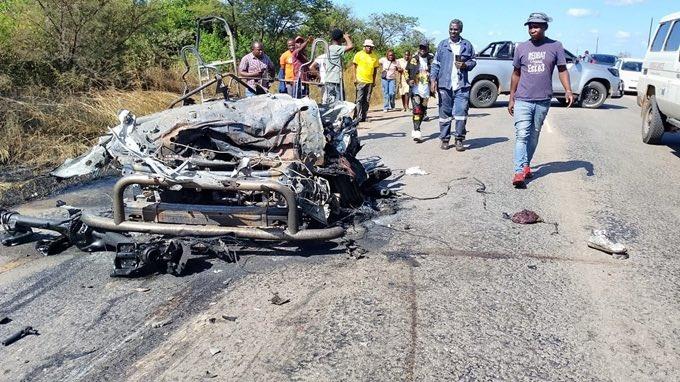
The Government has turned to forensic science to help identify victims of last week's devastating Toyota Quantum crash after the discovery of additional human remains raised concerns that the death toll may be higher than initially reported.
Authorities have engaged the National University of Science and Technology (NUST) to conduct DNA testing, which has now become central to identifying victims whose bodies were either mutilated or burnt beyond recognition.
Civil Protection Unit director-general Nathan Nkomo said the decision follows the discovery of a human skull and another body part at the crash site along the Bulawayo–Esigodini Road.
"The teams at the crash site discovered a skull and another body part on Sunday… this means that the figure can actually be higher than the reported 12," he said.
The grim discovery was made after a bereaved family joined recovery teams in search of a missing relative, prompting renewed combing of the accident scene.
Mr Nkomo said DNA analysis will be used not only on newly recovered remains but also on three bodies that were severely burnt in the explosion, making visual identification impossible.
He said government will cover all costs associated with the forensic work through the Civil Protection Unit.
"We are liaising with NUST, which has the necessary equipment to carry out the tests," he said.
The accident, involving a commuter omnibus travelling along the Bulawayo–Esigodini Road, was declared a state of disaster by President Emmerson Mnangagwa, as authorities moved to ensure dignified burials and a full investigation into the cause of the tragedy.
A mass funeral for 12 victims was held in Bulawayo, while families continue to search through debris at the crash site for personal belongings and possible remains of loved ones.
One grieving family member said identification without scientific testing had become impossible due to the severity of the destruction.
"Our brother had a big body… but to ascertain if it was his is a bit impossible," the relative said.
The tragedy has also triggered a parallel investigation into how explosives ended up in a public transport vehicle. Matebeleland South Minister of State for Provincial Affairs and Devolution Albert Nguluvhe questioned the circumstances surrounding the incident.
"Why were explosives in the car and why were they not identified? Who is selling these explosives?" he asked.
Authorities say investigations are ongoing as forensic teams work to establish the exact number of victims and the cause of the explosion that led to the fatal crash.
Authorities have engaged the National University of Science and Technology (NUST) to conduct DNA testing, which has now become central to identifying victims whose bodies were either mutilated or burnt beyond recognition.
Civil Protection Unit director-general Nathan Nkomo said the decision follows the discovery of a human skull and another body part at the crash site along the Bulawayo–Esigodini Road.
"The teams at the crash site discovered a skull and another body part on Sunday… this means that the figure can actually be higher than the reported 12," he said.
The grim discovery was made after a bereaved family joined recovery teams in search of a missing relative, prompting renewed combing of the accident scene.
Mr Nkomo said DNA analysis will be used not only on newly recovered remains but also on three bodies that were severely burnt in the explosion, making visual identification impossible.
He said government will cover all costs associated with the forensic work through the Civil Protection Unit.
"We are liaising with NUST, which has the necessary equipment to carry out the tests," he said.
The accident, involving a commuter omnibus travelling along the Bulawayo–Esigodini Road, was declared a state of disaster by President Emmerson Mnangagwa, as authorities moved to ensure dignified burials and a full investigation into the cause of the tragedy.
A mass funeral for 12 victims was held in Bulawayo, while families continue to search through debris at the crash site for personal belongings and possible remains of loved ones.
One grieving family member said identification without scientific testing had become impossible due to the severity of the destruction.
"Our brother had a big body… but to ascertain if it was his is a bit impossible," the relative said.
The tragedy has also triggered a parallel investigation into how explosives ended up in a public transport vehicle. Matebeleland South Minister of State for Provincial Affairs and Devolution Albert Nguluvhe questioned the circumstances surrounding the incident.
"Why were explosives in the car and why were they not identified? Who is selling these explosives?" he asked.
Authorities say investigations are ongoing as forensic teams work to establish the exact number of victims and the cause of the explosion that led to the fatal crash.
Source - The Herald
Join the discussion
Loading comments…





