News / National
Zimbabwe gold reserves boost confidence in ZiG
17 May 2026 at 11:54hrs |
0 Views
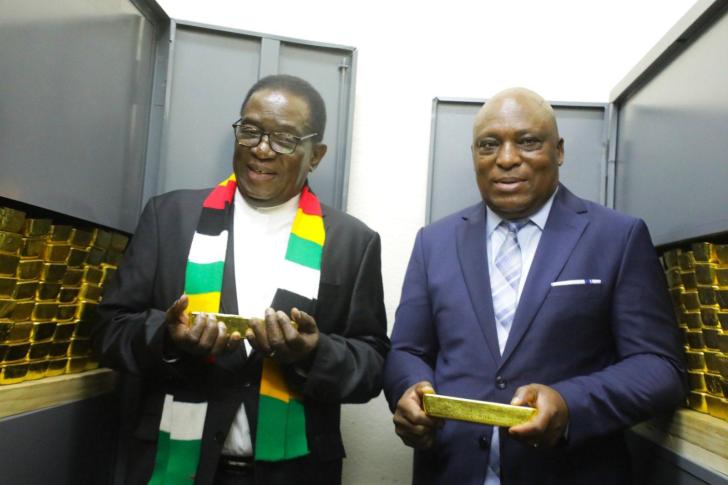
Zimbabwe's gold reserves have surged by 198,7 percent to 4,48 tonnes in just two years, strengthening confidence in the country's gold-backed currency, the Zimbabwe Gold (ZiG), amid continued efforts to stabilise the economy.
President Emmerson Mnangagwa revealed the latest reserve figures during an inspection of Reserve Bank of Zimbabwe vaults last week, describing the growing bullion stockpile as a major pillar of Zimbabwe's monetary sovereignty.
"These reserves are tangible assets that underpin our monetary sovereignty, rather than mere numbers," President Mnangagwa said.
Reserve Bank of Zimbabwe Governor John Mushayavanhu said Zimbabwe now holds more than US$1,4 billion in reserves backing ZiG.
"And that US$1,4 billion is predominantly composed of gold reserves, and we are continuing to grow it," Dr Mushayavanhu told journalists during the inspection.
According to the latest International Financial Statistics and World Gold Council data, Zimbabwe now ranks 11th in Africa for official gold holdings, with bullion accounting for nearly 48 percent of total reserve assets.
The reserve build-up comes as authorities seek to entrench ZiG as a stable currency after years of exchange rate instability, high inflation and volatility associated with previous local currency systems.
ZiG was introduced in April 2024 as a structured currency backed by physical gold and foreign currency reserves.
Unlike previous currency regimes, including bond notes, the RTGS dollar and the Zimbabwe dollar, ZiG is designed to limit excessive money creation by tying currency issuance to available reserves.
Economists say the growing reserves are helping strengthen public confidence in the currency while reducing inflation and exchange rate instability.
Economist Malone Gwadu said the increase in reserves, together with tighter monetary policy, was reinforcing currency stability.
"Well, I think the increase in the gold reserves to US$1,4 billion equivalent, coupled with reduced inflation levels to single digits, as well as amelioration of exchange volatility of the ZiG and the US dollar, is a cocktail of success factors for the currency," he said.
"They are complementing each other in the sense that the increase in reserves is reducing exchange instability and inflation rates in a sustainable manner, while also exuding economic confidence."
Gwadu said stable reserves were also helping anchor prices across the economy.
"The prices of products in the economy are supposed to be stable because inflation and exchange rates are largely under the leash now because of the tight monetary policy stance, coupled with reserves that can complement and provide defensive capabilities to the currency in the case of any volatilities or threats to stability," he said.
Since assuming office in March 2024, Dr Mushayavanhu has consistently emphasised monetary discipline and ruled out quasi-fiscal activities at the central bank.
The RBZ has maintained a tight monetary stance, keeping the policy interest rate at 35 percent to limit speculative borrowing and excessive liquidity growth.
As a result, annual inflation has reportedly fallen from above 90 percent in late 2025 to 4,8 percent by April 2026, while the gap between official and parallel market exchange rates has narrowed significantly.
ZiG currently trades at around 25 to 26 ZiG per US dollar.
Economist Farai Mabika said reserve accumulation was both economically and psychologically important for rebuilding trust in the local currency.
"Gold reserves help improve confidence because they provide a tangible backing structure to the monetary system," he said.
"In Zimbabwe's case, where confidence in local currencies has historically been fragile, reserve accumulation becomes psychologically and economically important."
However, he cautioned that reserve growth alone would not guarantee long-term economic stability.
"Reserve growth must move together with fiscal discipline, export growth, productivity and policy consistency. Gold is an important buffer, but it cannot replace broader economic fundamentals," Dr Mabika said.
Banker Raymond Madziwa said stronger reserves improved investor confidence and enhanced the country's ability to absorb external shocks.
"Reserve accumulation sends an important signal regarding monetary discipline and financial preparedness," he said.
"Investors and markets generally gain confidence when a country demonstrates a stronger capacity to defend its currency and absorb external shocks."
Zimbabwe's reserves currently cover about 1,6 months of imports, below the internationally preferred benchmark of three months. Analysts say authorities will likely continue building reserves through increased gold deliveries, export growth and foreign currency generation.
Across Africa, Algeria remains the continent's largest gold holder with 173,6 tonnes, followed by Libya, Egypt and South Africa.
Analysts say central banks globally are increasingly turning to gold reserves amid geopolitical uncertainty, inflation concerns and efforts to reduce dependence on the US dollar.
President Emmerson Mnangagwa revealed the latest reserve figures during an inspection of Reserve Bank of Zimbabwe vaults last week, describing the growing bullion stockpile as a major pillar of Zimbabwe's monetary sovereignty.
"These reserves are tangible assets that underpin our monetary sovereignty, rather than mere numbers," President Mnangagwa said.
Reserve Bank of Zimbabwe Governor John Mushayavanhu said Zimbabwe now holds more than US$1,4 billion in reserves backing ZiG.
"And that US$1,4 billion is predominantly composed of gold reserves, and we are continuing to grow it," Dr Mushayavanhu told journalists during the inspection.
According to the latest International Financial Statistics and World Gold Council data, Zimbabwe now ranks 11th in Africa for official gold holdings, with bullion accounting for nearly 48 percent of total reserve assets.
The reserve build-up comes as authorities seek to entrench ZiG as a stable currency after years of exchange rate instability, high inflation and volatility associated with previous local currency systems.
ZiG was introduced in April 2024 as a structured currency backed by physical gold and foreign currency reserves.
Unlike previous currency regimes, including bond notes, the RTGS dollar and the Zimbabwe dollar, ZiG is designed to limit excessive money creation by tying currency issuance to available reserves.
Economists say the growing reserves are helping strengthen public confidence in the currency while reducing inflation and exchange rate instability.
Economist Malone Gwadu said the increase in reserves, together with tighter monetary policy, was reinforcing currency stability.
"Well, I think the increase in the gold reserves to US$1,4 billion equivalent, coupled with reduced inflation levels to single digits, as well as amelioration of exchange volatility of the ZiG and the US dollar, is a cocktail of success factors for the currency," he said.
"They are complementing each other in the sense that the increase in reserves is reducing exchange instability and inflation rates in a sustainable manner, while also exuding economic confidence."
Gwadu said stable reserves were also helping anchor prices across the economy.
"The prices of products in the economy are supposed to be stable because inflation and exchange rates are largely under the leash now because of the tight monetary policy stance, coupled with reserves that can complement and provide defensive capabilities to the currency in the case of any volatilities or threats to stability," he said.
The RBZ has maintained a tight monetary stance, keeping the policy interest rate at 35 percent to limit speculative borrowing and excessive liquidity growth.
As a result, annual inflation has reportedly fallen from above 90 percent in late 2025 to 4,8 percent by April 2026, while the gap between official and parallel market exchange rates has narrowed significantly.
ZiG currently trades at around 25 to 26 ZiG per US dollar.
Economist Farai Mabika said reserve accumulation was both economically and psychologically important for rebuilding trust in the local currency.
"Gold reserves help improve confidence because they provide a tangible backing structure to the monetary system," he said.
"In Zimbabwe's case, where confidence in local currencies has historically been fragile, reserve accumulation becomes psychologically and economically important."
However, he cautioned that reserve growth alone would not guarantee long-term economic stability.
"Reserve growth must move together with fiscal discipline, export growth, productivity and policy consistency. Gold is an important buffer, but it cannot replace broader economic fundamentals," Dr Mabika said.
Banker Raymond Madziwa said stronger reserves improved investor confidence and enhanced the country's ability to absorb external shocks.
"Reserve accumulation sends an important signal regarding monetary discipline and financial preparedness," he said.
"Investors and markets generally gain confidence when a country demonstrates a stronger capacity to defend its currency and absorb external shocks."
Zimbabwe's reserves currently cover about 1,6 months of imports, below the internationally preferred benchmark of three months. Analysts say authorities will likely continue building reserves through increased gold deliveries, export growth and foreign currency generation.
Across Africa, Algeria remains the continent's largest gold holder with 173,6 tonnes, followed by Libya, Egypt and South Africa.
Analysts say central banks globally are increasingly turning to gold reserves amid geopolitical uncertainty, inflation concerns and efforts to reduce dependence on the US dollar.
Source - Sunday News
Join the discussion
Loading comments…


