Opinion / Columnist
How Africans were conditioned into maize - and slowly abandoned their healthier grains
04 Dec 2025 at 17:19hrs |
0 Views
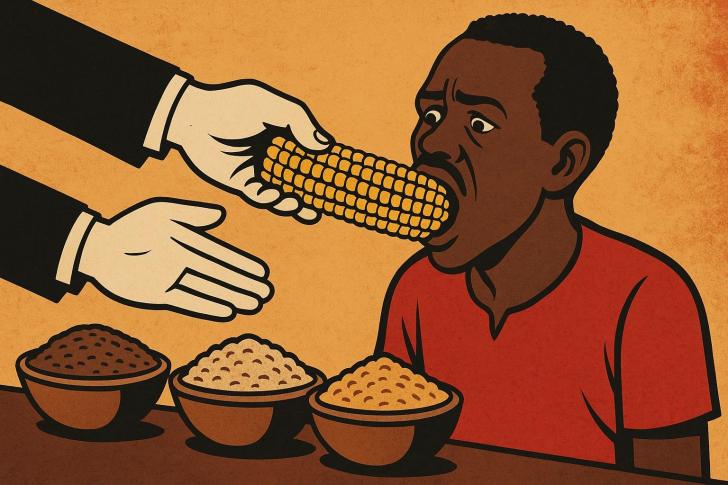
For millennia, African societies nourished themselves on hardy, nutrient-dense grains such as uphoko (rapoko/zviyo), sorghum, and millet. These crops were not merely sources of sustenance - they underpinned entire cultural identities. They shaped rituals, anchored agricultural calendars, and sustained communities through droughts and political upheavals. These grains were both food and philosophy: a way of living that respected the land's rhythms.
Yet today, we behold a continent where maize isitshwala has become the unquestioned staple - a staple that, ironically, was never indigenous to African soil.
Maize is an import. It arrived from the Americas through Portuguese traders in the 1500s, only later becoming deeply embedded through colonial agricultural systems. European settlers initially grew maize to feed cattle and supply commercial markets. But over time, African populations were systematically encouraged - coerced, misled, or outright indoctrinated - to adopt it as their primary food. White maize became associated with progress and modernity, while traditional grains were recast as backward, primitive, or "poor people's food."
This wasn't an innocent culinary evolution. It was a deliberate cultural re-engineering.
Colonial administrations reorganised African food systems around controllable, market-oriented crops. Indigenous grains - resilient, nutrient-rich, and culturally central - lost their institutional support. Agricultural extension programs, pricing incentives, and food aid systems all reinforced maize monoculture. Over generations, this reshaped not only eating habits but cultural memory. Communities began to forget the sophistication of their ancestral diets.
The consequences have been severe.
Maize, while filling, is nutritionally limited. It depletes soils more rapidly, demands substantial water, and is dangerously vulnerable to climate variability. When rains fail, entire regions buckle. Zimbabwe's recurrent food crises reflect this fragility: a nation that once fed itself with drought-resistant grains now swings between scarcity and dependency.
In contrast, uphoko, sorghum, and millet represent a blueprint for climate resilience. These grains flourish in marginal soils, withstand drought, and provide a wider range of essential nutrients - fibre, iron, calcium, and plant-based protein. They are, in every sense, superfoods engineered by centuries of indigenous knowledge rather than colonial preference.
And the tide is turning.
Across the continent, a resurgence is underway. Farmers are reviving millet fields. Nutritionists are reframing traditional grains as engines of wellness. Cultural leaders are reclaiming them as heritage symbols rather than relics of deprivation. The global health food industry has finally "discovered" what African communities once knew intuitively: these grains are not inferior. They are ingenious.
If Africa is serious about food sovereignty, public health, and ecological stability, it must confront the legacy of maize dependency. Not to eliminate maize entirely, but to dethrone it from a position it was never meant to hold.
For too long, Africans were taught to revere maize while sidelining the foods that truly made them strong. A decolonised diet is not nostalgia - it is strategy, survival, and self-restoration. The future lies in re-centering uphoko, sorghum, millet, and the ancestral wisdom they carry.
Yet today, we behold a continent where maize isitshwala has become the unquestioned staple - a staple that, ironically, was never indigenous to African soil.
Maize is an import. It arrived from the Americas through Portuguese traders in the 1500s, only later becoming deeply embedded through colonial agricultural systems. European settlers initially grew maize to feed cattle and supply commercial markets. But over time, African populations were systematically encouraged - coerced, misled, or outright indoctrinated - to adopt it as their primary food. White maize became associated with progress and modernity, while traditional grains were recast as backward, primitive, or "poor people's food."
This wasn't an innocent culinary evolution. It was a deliberate cultural re-engineering.
Colonial administrations reorganised African food systems around controllable, market-oriented crops. Indigenous grains - resilient, nutrient-rich, and culturally central - lost their institutional support. Agricultural extension programs, pricing incentives, and food aid systems all reinforced maize monoculture. Over generations, this reshaped not only eating habits but cultural memory. Communities began to forget the sophistication of their ancestral diets.
The consequences have been severe.
In contrast, uphoko, sorghum, and millet represent a blueprint for climate resilience. These grains flourish in marginal soils, withstand drought, and provide a wider range of essential nutrients - fibre, iron, calcium, and plant-based protein. They are, in every sense, superfoods engineered by centuries of indigenous knowledge rather than colonial preference.
And the tide is turning.
Across the continent, a resurgence is underway. Farmers are reviving millet fields. Nutritionists are reframing traditional grains as engines of wellness. Cultural leaders are reclaiming them as heritage symbols rather than relics of deprivation. The global health food industry has finally "discovered" what African communities once knew intuitively: these grains are not inferior. They are ingenious.
If Africa is serious about food sovereignty, public health, and ecological stability, it must confront the legacy of maize dependency. Not to eliminate maize entirely, but to dethrone it from a position it was never meant to hold.
For too long, Africans were taught to revere maize while sidelining the foods that truly made them strong. A decolonised diet is not nostalgia - it is strategy, survival, and self-restoration. The future lies in re-centering uphoko, sorghum, millet, and the ancestral wisdom they carry.
Source - Sukuzukuduma
All articles and letters published on Bulawayo24 have been independently written by members of Bulawayo24's community. The views of users published on Bulawayo24 are therefore their own and do not necessarily represent the views of Bulawayo24. Bulawayo24 editors also reserve the right to edit or delete any and all comments received.
Join the discussion
Loading comments…



