Sports / Soccer
Experts warn FIFA over extreme heat risks ahead of 2026 World Cup
14 May 2026 at 07:13hrs |
1214 Views
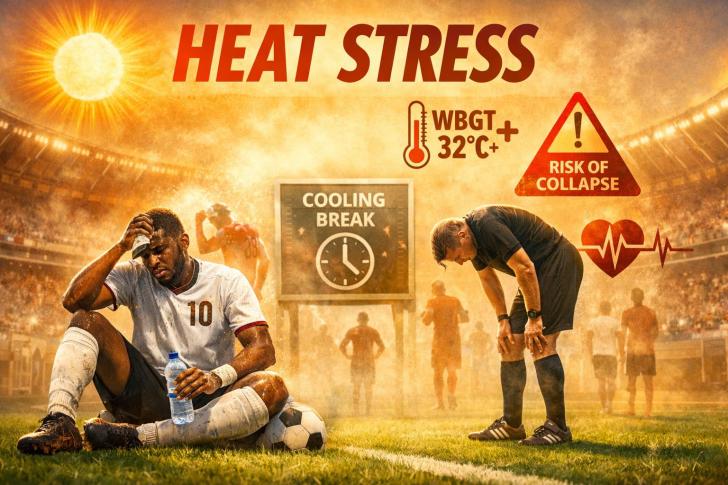
A coalition of leading medical, climate and sports science experts has issued a stark warning to FIFA, urging the global football body to urgently strengthen its heat‑stress protocols ahead of the 2026 men's World Cup.
In an open letter dated 13 May 2026, more than 20 specialists in intensive care, public health, climate science and elite sports performance said current FIFA guidelines are outdated and could expose players, referees and match officials to dangerous levels of heat stress during the tournament. The World Cup will be staged across the United States, Mexico and Canada, regions expected to experience severe heat conditions during the summer months.
The experts argue that FIFA has not meaningfully updated its heat‑management standards since 2015, despite its own 2025 medical strategy promising evidence‑based policies that proactively address emerging health threats, including climate change.
According to the letter, FIFA's current threshold for mandatory cooling breaks - a wet bulb globe temperature (WBGT) above 32°C - is far higher than levels recognised as hazardous in occupational health and elite sport. The WBGT index measures the combined effects of temperature, humidity, sunlight and wind on the human body.
The signatories say a WBGT of 26°C already represents a high‑risk environment for competitive football, with athletes unable to maintain thermal balance during high‑intensity play. They warn that short cooling breaks cannot prevent dangerous rises in core body temperature once environmental heat exceeds safe limits.
The group cites international standards showing that heat‑related injury risks begin at WBGT levels far below FIFA's current threshold. They also note that match officials, particularly referees, face heightened vulnerability due to lower conditioning levels compared to elite players.
The experts are calling on FIFA to adopt the more conservative guidelines proposed by global players' union FIFPRO, which recommend cooling breaks from 26°C and postponement of fixtures above 28°C. They also urge FIFA to extend cooling breaks to at least six minutes and ensure locker rooms are equipped for aggressive pre‑game and half‑time cooling.
Beyond match‑day protocols, the letter highlights what it describes as a structural conflict of interest: the continued promotion of fossil fuel sponsors despite the well‑documented role of fossil fuel emissions in driving extreme heat conditions.
The signatories say player welfare must remain the foundation of football governance and ask FIFA to confirm whether it will update its guidelines in line with current science.
The letter is signed by prominent figures including Professor Hugh Montgomery of University College London, Professor Mike Tipton of the University of Portsmouth, Professor Douglas Casa of the University of Connecticut, and several climate and health researchers from Europe, North America and Asia.
FIFA has not yet publicly responded to the concerns raised.
In an open letter dated 13 May 2026, more than 20 specialists in intensive care, public health, climate science and elite sports performance said current FIFA guidelines are outdated and could expose players, referees and match officials to dangerous levels of heat stress during the tournament. The World Cup will be staged across the United States, Mexico and Canada, regions expected to experience severe heat conditions during the summer months.
The experts argue that FIFA has not meaningfully updated its heat‑management standards since 2015, despite its own 2025 medical strategy promising evidence‑based policies that proactively address emerging health threats, including climate change.
According to the letter, FIFA's current threshold for mandatory cooling breaks - a wet bulb globe temperature (WBGT) above 32°C - is far higher than levels recognised as hazardous in occupational health and elite sport. The WBGT index measures the combined effects of temperature, humidity, sunlight and wind on the human body.
The signatories say a WBGT of 26°C already represents a high‑risk environment for competitive football, with athletes unable to maintain thermal balance during high‑intensity play. They warn that short cooling breaks cannot prevent dangerous rises in core body temperature once environmental heat exceeds safe limits.
The experts are calling on FIFA to adopt the more conservative guidelines proposed by global players' union FIFPRO, which recommend cooling breaks from 26°C and postponement of fixtures above 28°C. They also urge FIFA to extend cooling breaks to at least six minutes and ensure locker rooms are equipped for aggressive pre‑game and half‑time cooling.
Beyond match‑day protocols, the letter highlights what it describes as a structural conflict of interest: the continued promotion of fossil fuel sponsors despite the well‑documented role of fossil fuel emissions in driving extreme heat conditions.
The signatories say player welfare must remain the foundation of football governance and ask FIFA to confirm whether it will update its guidelines in line with current science.
The letter is signed by prominent figures including Professor Hugh Montgomery of University College London, Professor Mike Tipton of the University of Portsmouth, Professor Douglas Casa of the University of Connecticut, and several climate and health researchers from Europe, North America and Asia.
FIFA has not yet publicly responded to the concerns raised.
Source - www.newweather.org
Join the discussion
Loading comments…



